
CHAPTER 14
THE INITIAL RECORDING OF PROPERTY RIGHTS
14.0 Introduction
14.0.1 Context
14.0.2 The purpose of this chapter
14.1 This example; PIOs and POT graphs
14.1.1 The storyline of the example
14.1.2 The PIO and POT graph for past, desired and feared future performance
14.2 The Process of Determining Property Rights and their Recording
14.2.1 The IRPR process at a very high level
14.2.2 The main activities in the IRPR process at an operational level
14.2.3 The IRPR operational process as a SD processing chain
14.3 Work teams and the rate at which work is done along the IRPR processing chain
14.3.1 A generic SCS for calculating the work capacity of IRPR processing teams
14.3.2 A generic SCS for calculating the cost to establish and operate IRPR teams
14.3.3 A composite SCS for conducting IRPR
14.3.4 Team productivity and technical methods/options for executing a IRPR task
14.4 The Options available to the province for conducting IRPR.
14.4.1 Fit-for-Purpose (FFP) approach to Land Admin to Provide Secure Land Rights at Scale.
14.4.2 The broad options for IPPR available to the province with advantages & disadvantages
14.5 Productivity of IRPR teams and costs to operate; use of different technologies
14.5.1 Different technologies used in IRPR
14.5.2 A first pass estimates of team size, productivity and unit costs for each team type and each option
14.6 The SD model
14.6.1 Cost & time estimates from the model to execute IRPR for each option
14.6.2 Human resources required
14.6.3 Main Takeaways from the SD model and previous sections
14.6.4 Model fitness for purpose and limitations
14.7 Where the analysis is at- remaining task, identification of key issues
14.7.1 The key issues
14.7.2 Comments on each key issue by the analysis team
14.7.3 Suggested next steps and pointers for strategy for IRPR
14.8 Results from a briefing to SPOs (senior provincial officials)
14.9 Other points
14.9.1 Things that could be included in further passes of the model
14.9.2 How this model could be integrated with models from previous examples
14.10 Key Points
Figures
14.1 POT graph of the PIO
14.2 A very high level representation of the IRPR processing chain
- A SCS (schematic) of the core structure of the IRPR process
- A generic SCS structure for a work team
- A generic SCS structure for the cost of establishing & operating a work team
14.6 An expanded SCS for the IRPR processing chain of Fig 14.3 including “panels” for work teams
14.7 Human resources required overall and by IRPR team type and for each IRPR option
14.8 Major risks and mitigation action
Tables
14.1a The main activities in the IRPR process at an operational level
14.1b Supporting activities
14.2 The key principles of the FFP approach From Enemark et al (2016).
14.3 The broad options for IRPR available to the province and advantages and disadvantages
14.4 Template inputs for team structure for each team type for each option
14.5 Template inputs for unit costs to establish and operate each team type for each option
14.6 Cost & time estimates from the SD model to execute IRPR for each option
Annexes
- The IRPR as a schematic SD processing chain (Fig 14.3 enlarged in landscape)
- A generic SCS structure for a IRPR processing team (Fig 14.4 enlarged)
C. The schema of how skill levels effect work capacity developed in Chapter 10.
D. A generic SCS for the cost to establish and operate a IRPR processing team (Fig 14.5 enlarged)
E. Figs 14.4 & 5 combined
F. An expanded Fig 14.6 which includes the SCS for a team structure and team costs.
G. Extracts and Comments re FFP from some Papers in the 2 Special Volumes of Land 2021
H. Notes on Content of Some Papers made by the Analysis Team
I. a 1st pass at number of team, team size and productivity for the different team types for each option
J. a 1st pass at unit costs to establish and operate the teams for the different team types for each option
K. Human resources needed for each IRPR option, in total and by team type; Fig 14.7 in landscape
L. Abbreviations used
CHAPTER 14
THE INITIAL RECORDING OF PROPERTY RIGHTS
14.0 Introduction
14.0.1 Context
The chapters so far have focused on the “formal” (government) system of land administration and in particular various aspects that affect the performance/reputation/quality of a Land Registry (LR).
This chapter looks at the development task of the initial recording of property rights (IRPR)1 in quantity (say from 10,000 to 100,000+ properties). IRPR is distinct from the normal subdivision of land (say 2 to 20 lots) that is already registered in a LR, and the periodic first time bringing of land/property “onto the register”, carried out at an owners/rights holders request and paid for by the rights holders.
14.0.2 The purpose of this chapter
The purpose of this chapter is to provide an example of how the SD approach could be used for IRPR.
14.1 This example; PIOs and POT graphs
14.1.1 The storyline of this example
Setting
A province in a developing country. The province has six districts each of which has a LR. Each district has a significant number of properties where rights have not yet been formally determined and recorded.
Background
Senior provincial officials (SFOs) have previously used the SD (strategy dynamics) approach to better understand a number of land administration issues before undertaking action. The issues examined so far have been; –
- Removing a backlog in an LR with aid, and keeping it low post aid (Chapters 4-7)
- Increasing quality and reputation in an LR, winning back customers, increasing revenue, achieving adequate budgets and financially sustaining improvements post aid. (Chapter 9)
- Treating quality as being composed of a number of subcomponents where only some are under the control of a LR. (Chapter 11)
- Developing a staff development and skilling plan. (Chapter 10)
- Addressing the payment of informal fees. (Chapter 12)
- The raising of development capital if the “Quality of Titles” are sufficiently high for banks to be willing to accept titles as collateral for a loan. (Chapter 13)
Current situation
The SPOs now wish to better understand the implications of undertaking IRPR to improve the security of property rights for those whose properties are not yet registered in the LR. The SPOs have heard of an approach called Fit-for-Purpose Land Administration but know little about it, or how IRPR could be undertaken under existing provincial laws and regulations.
The SPOs have established a small analysis team comprising the following; – the in country (IC) SD consultant used previously; the managers of a PLO (provincial land office) and a district LR; a senior surveyor with experience in the subdivision of land/property; a senior lawyer specialising in land law.
It was decided that the analysis would be done for one district that has its own LR. It was estimated that the district had 40,000 properties registered in the district LR and there were about 10,000 properties in the district that had not yet had their property rights formally determined and recorded.
The purpose of the analysis and the use of the SD approach is for the SPOs to better understand, at a high level:-
- The process of conducting IRPR; options for carrying out; advantages and disadvantages
- The magnitude of the task; likely duration, costs, resources to carry out;
- the key issues involved [e.g. impact on current operations, organisations, resources; necessity for aid; risks, etc.]
It was anticipated that further work would be required after this initial high level analysis was completed.
The following sections outline the work and considerations of the analysis team.
14.1.2 The PIOs and their POT graphs for past, desired and feared future performances
The first step in applying the SD approach (as in previous examples) is the stating of PIOs (performance improvement objectives) and the compilation of their POT (performance over time) graphs for past, desired and feared future performances.
PIOs (performance improvement objectives)
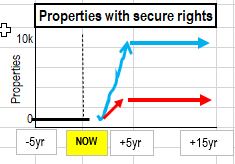
The PIO was determined to be:- To provide secure property rights to ~10k properties (in one district)
POT graph for the PIO showing past, desired and feared future performance
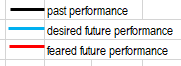
The POT graphs in Fig 14.1 for the PIOs are indicative and were compiled by the analysis team.
Fig 14.1
Reasons why so many properties do not yet have property rights recorded
The analysis team developed a Why, Why, Why diagram and found the reasons why so many properties do not yet have property rights recorded were:-
- It was too costly to conduct IRPR both for the province and for individual property “owners” due to existing regulations
- Many property “owners” could see little advantage in doing IRPR as they were able to buy/sell property and pass to their heirs informally, without government documentation
- Some property “owners” had low trust in the integrity of operations in provincial LO/LR and would rather not use
14.2 The Process of Determining Property Rights & their Recording
Up to the late 1990s aid projects that focused on or included the large scale determination of property rights and registering those rights in a government LR, or similar were found to be very slow and expensive. Costs were reported to be in the order of US$50 per property. The main factors affecting costs were legal requirements that affected the process and costs by mandating :-the process; technology to be used or requiring very high spatial accuracy for boundaries; only personnel with a government licence to be used in particular parts of the process (e.g. certified property surveyors and lawyers/notaries).
It was recognised that the above approach would not meet the needs of the millions who did not have secure property rights and this led to the Fit-for-Purpose (FFP) approach to Land Administration to Provide Secure Land Rights at Scale. FFP aims to significantly lower the time and cost for IRPR. More in Sec14.4.1.
14.2.1 The IRPR Process at a very high level
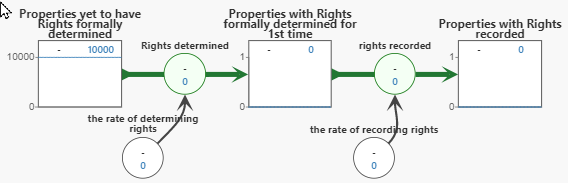
Fig 14.2 is a very high level schematic of the processing chain
Fig 14.2
Comments on Fig 14.2
- Initially there are a number of properties whose rights have not been formally determined. Shown as a stock on the left with 10,000 properties.
- As IRPR is undertaken properties have their rights determined (the middle stock) and then recorded (the stock on the right). The value of each stock at any point in time depends the rate of the respective inflows/outflows (rights determined, rights recorded) The bathtub analogy in Chapter 4, Sec 4.6.1 refers.
- The rate of determining rights and recording rights depends on the work force allocated and their productivity. More in Sec 14.3.
14.2.2 The Main activities in the IRPR process at an operational level
Operationally there are a number of steps. The common ones are listed in the first column in Table 14.1a below. The abbreviated names in the third column will be mainly used in the remainder of the chapter.
Table 14.1a
|
Step |
Aim |
Abbreviated term used |
|
Community awareness & engagement in IRPR |
To identify those willing to participate in IRPR, after becoming informed and contacted |
Awareness & Contacting |
|
Recording of rights claims and boundaries |
To record all rights claims & associated boundaries |
Right claims recording |
|
Right claims publication, adjudication, and identification of those where dispute resolution is necessary |
To publicly publish in the community all claims, adjudicate as necessary, & identify where dispute resolution is necessary |
Adjudication |
|
Resolution of disputes where possible |
To resolve disputes where possible |
Dispute resolution |
|
Preparation of formal documentation recording rights |
To prepare formal rights documentation |
Rights documentation preparation |
|
Rights recording and issuance of rights documents after any fees paid, |
To record rights and issue rights documents, after payment of any necessary fees |
Rights recording |
Two activities, shown in Table 14.1b, supporting the main process, are also necessary.
Table 14.1b Supporting activities
|
Activity |
Aim |
Abbreviated term used |
|
Data management and technical support |
Data support |
|
|
IRPR site /activity management & QC (quality control) |
IRPR site management & QC |
14.2.3 The IRPR operational process as a SD processing chain
Illustrations of the use of SD as a processing chain have been shown in some previous chapters. viz in Chapter 9 for winning back titleholders who no longer used the LR; Fig 9.6, the customer pipeline refers. The chain in Fig 9.6 comprises various stocks such as:- not aware; aware; informed, etc. In Chapter 10 there was a staff chain with two stocks of junior staff and senior staff; Fig 10.3 refers.
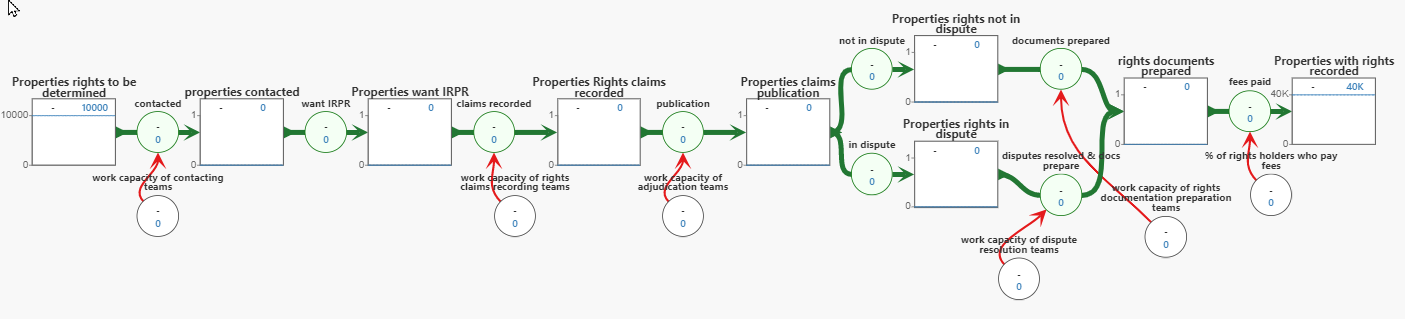
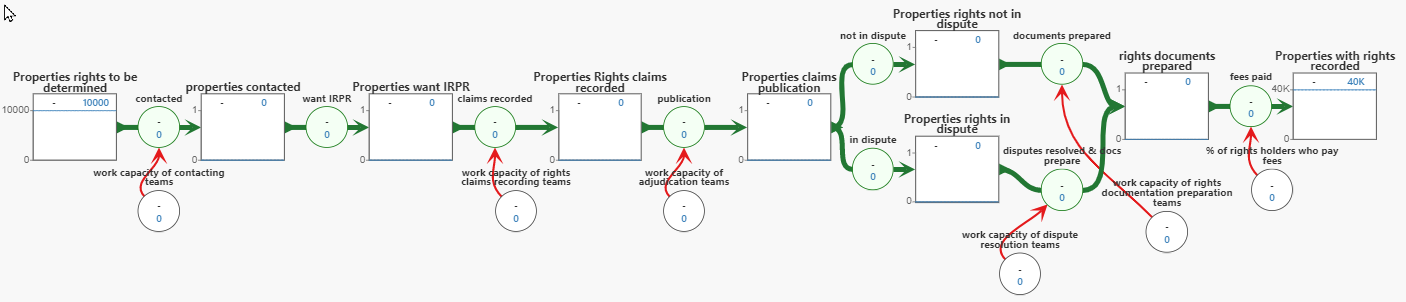
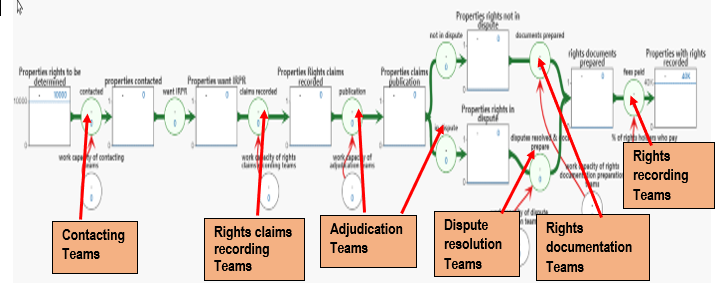
Fig 14.3 is a part SCS (schematic of the core structure) of the IRPR processing chain and shows Fig 14.2 in more detail taking into account the IRPR process names outlined in Table 14.1a. Annex A shows Fig 14.3 in landscape.
Fig 14.3
Comments on Fig 14.3
- The red arrows coming into the various flows along the IRPR processing chain emanate from variables that provide values for the work capacity of the various types of work team described in Table 14.1a. e.g. work teams for:- awareness & contacting properties; the recording of rights claims; adjudication, etc. More about these work teams in Sec 14.3.
14.3 Work teams and the rate at which work is done along the IRPR processing chain
As illustrated in Fig 14.3, the rate at which work gets done along the processing chain depends on the work capacity of each particular work team (as listed in Table 14.1), which in turn depends on:-
- The number of work teams and the number of people in each work team
- The skills/experience of team members and the effect of skill/experience on productivity
- The productivity of a work team (in turn depends on process followed and technology)
- The time spent on the job
- The structure that relates to all the above
These will be examined in the following sections.
14.3.1 A generic SCS for calculating the work capacity of IRPR processing teams
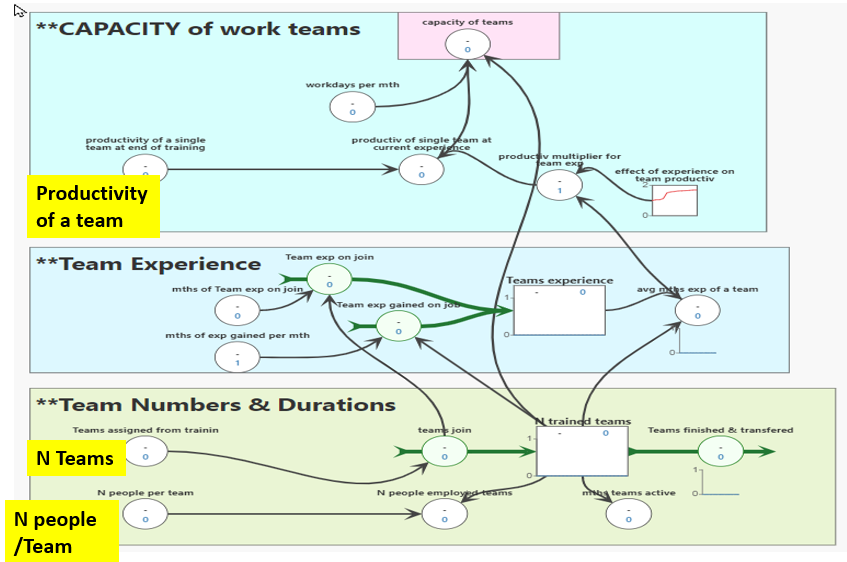
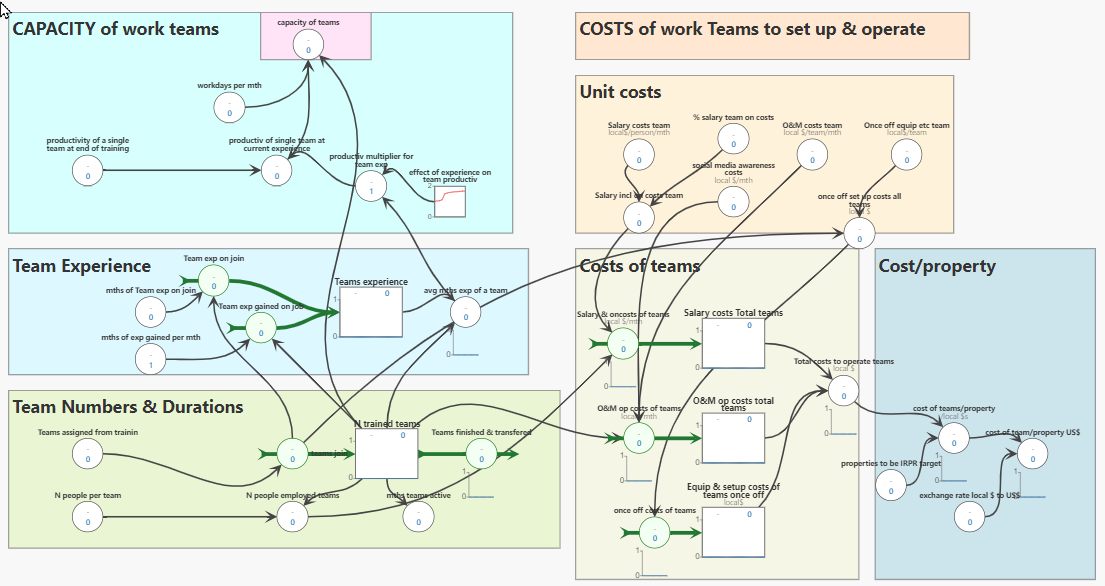
Fig 14.4 shows a generic SD structure for a work team which results in a calculation for “capacity of work teams ”. Annex B shows an enlarged Fig 14.4.
Fig 14.4
The main structure of the schema
Fig 14.4 above adapts part of the schema used in Chapter 10 which dealt with staff and skills development and how they affect capacity. Fig 10.3, shown in Annex C with some comments, shows the schema of how skill levels affect work capacity, as developed in Chapter 10.
The structure of Fig 14.4 differs from that developed in Chapter 10 as follows:-
- There is only one type of team, trained teams
- Experience (of teams) is used instead of skills, and experience is gained on the job
- Salaries are not used here, but are incorporated when costs are considered (Sec 14.3.2 refers)
- Teams join when they finish their initial training, and leave when they finish their respective processing task. e.g. contacting property holders to explain IRPR; recording property rights claims; etc.
The main determinants of the work capacity of teams
From the above it can be seen the key determinants of the work capacity of a team are:-
- The numbers of teams and when they become available from training
- The number of people in a team
- The productivity of a team at the completion of training
- The increase in productivity of a team as it gains experience and confidence on the job
The productivity of a team will greatly depend on the team type, the task itself, the skill and knowledge required, the process followed and the technology used. More in Sec 14.3.4.
The above structure can be used for each team type where the main variables are points 1-4 above.
14.3.2 A generic SCS for calculating the cost to establish and operate a IRPR processing team
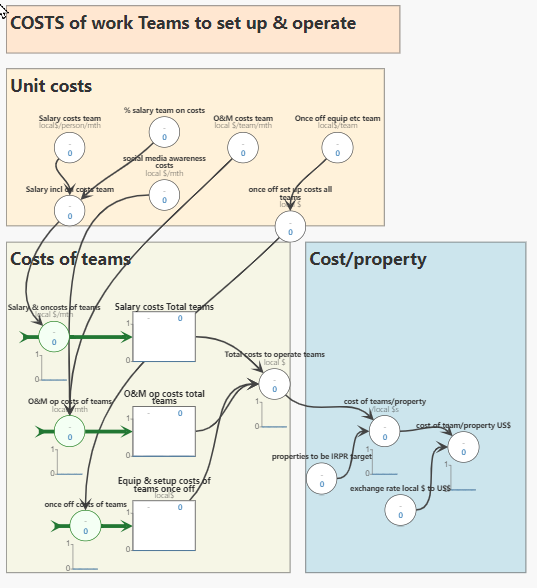
Fig 14.5 shows a SCS of calculating the cost to establish and operate a IRPR processing team.
Fig 14.5
Comments on Fig 14.5
- Annex D shows Fig 14.5 enlarged and Annex E shows Figures 14.4 and 14.5 combined.
- Unit costs (in local $s) are assigned for: salaries & oncosts/mth; O&M costs/mth; social media costs/mth; once off costs to set up a team.
- Totals (in local $s) are calculated for salaries, O&M, once off costs, and for total costs.
- A cost /property in US$ is calculated.
- The structure is very similar to that used in Chapters 5 and 6 when determining project costs for removing a backlog.
14.3.3 A composite SCS for conducting IRPR
Fig 14.6 shows an expanded SCS for the IRPR processing chain of Fig 14.3 including “panels” (coloured brown) which contain the team structure of Fig 14.4 and an output of “capacity of teams”. These become the value for the relevant flows in the IRPR processing chain. These panels are named using Table 14.1a,b column 3.
Fig 14.6
Site supporting Teams
Annex F shows an expanded view of Fig 14.6 which includes the SCS for a team structure and team costs. This could be used to start guiding the building of a SD model.
14.3.4 Team productivity and technical methods/options for executing a IRPR task
It could be argued that the IRPR process could be depicted differently and IRPR teams named and constituted differently from Fig 14.5. But however depicted and constituted, the core tasks are:-
- Providing awareness to properties concerning secure properties rights and IRPR
- Recording peoples claims to property rights
- The adjudication of rights claims and the resolution of disputes
- The recording of rights claims not in dispute
Whatever ways the tasks are split, there will be a productivity (the rate at which a task is done/team/month) associated with an individual team for each task. The rate will be different for each different task type and will depend on:-
- The inherent nature of the task (e.g. providing awareness to properties is not as complex and time consuming as recording rights claims)
- The skills/knowledge/experience required to do the task efficiently and the current level of a team’s proficiency
- The process followed in doing the task (e.g. some parts of the IRPR process may be mandated by laws & regulations)
- The technology used. Existing laws and regulation may mandate techniques or accuracy to be attained, particularly for rights’ boundaries. Other technology may produce less accurate results but have a much greater productivity, require a lower skill level and less training, and be of lower cost).
Productivity is discussed further in Sec 14.5.
14.4 The Options available to the province for conducting IRPR.
The introduction to Sec 14.2 briefly mentioned why the Fit-for-Purpose (FFP) approach has gained much attention in recent years. This is examined here in a little more detail when considering the options that might be available to the province for IRPR.
14.4.1 Fit-for-Purpose (FFP) approach to Land Admin to Provide Secure Land Rights at Scale.
The aim of the SPO’s analysis team at this time was to understand sufficiently enough the FFP approach to enable them to determine the broad options available to the province for IRPR. More on these options in Sec 14.4.2.
The following notes what the SPO’s analysis team deduced when it examined some key papers on the FFP approach.
The need for the FFP approach
The need can be summarised from Enemark, S et al (2014), as:-
- 75% of the world population do not have access to formal systems to register and safeguard their land rights and the majority of these are the poor. This is a human rights issue.
- It is impossible for the current western style LA paradigm to quickly scale up to include the 75% because traditional LA requires high accuracy and expensive land surveying techniques to record land rights. It is time to rethink how land rights are recorded and managed.
- There is an urgent need to build cost-effective and sustainable systems which can quickly identify the way land is occupied and used and, accordingly, provide for secure land rights. FFP is such an approach.
The key characteristics of the FFP approach
The key characteristics extracted from Enemark et al (2014) and Enemark et al (2016), are:-
- Design for the purpose of managing current land issues within a specific country or region, rather than simply following more advanced technical standards.
- Focus on the purpose, flexibility, and incremental improvement
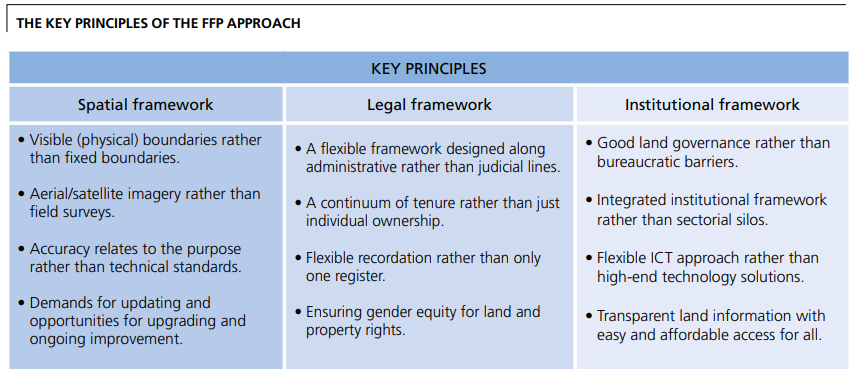
- There are three interrelated core components: a spatial framework, a legal framework, and an institutional framework. Characteristics shown in Table 14.2 below. From Enemark et al (2016).
Table 14.2
The kernel of the FFP approach
The kernel of the FFP approach, summarised from Enemark et al (2014) and (2016) is:-
- Align FFP with a country’s needs, be participatory, be affordable, be flexible to accommodate different types of land use and be capable of upgrading
- Adopt a legal framework that accommodates flexibility necessary for implementing an FFP approach and implement within a robust land governance framework
- When assessing technology and investment choice, the focus should be on the FFP approach that:-
- will meet the needs of society today and can be incrementally improved over time.
- will facilitate economic growth, social equity and environmental sustainability to be better supported pursued and achieved
- can be sustained operationally and financially in the long term
Major Challenges
Major challenges were noted in Enemark et al (2016) as:-
- A mind set change by land professionals to not be driven by state of the art positioning and surveying technology2
- Revising the legal framework to provide the required flexibility to accommodate the FFP approach
- To have effective institutional arrangements
- The need for capacity development to build scale quickly
Major lessons learnt to date in implementing the FFP approach
The SPO’s analysis team noted that a recent special edition of Land, Enemark, et al (2021), contained 26 papers in two volumes reporting on experience with implementing the FFP approach. The team scanned the papers with the aim of identifying the major lessons learnt and help their identification of high level options for IRPR in the province. Some notes were made (Annex G) for use when a more detailed examination of these papers, post this current task.
The major lessons /observations drawn by the SPO’s analysis team at this time were:-
- FFP is substantially quicker and of lower cost for IRPR than the traditional western approach and needs a shift in priorities from “good but slow” (cost US$~50/property) to “good enough but fast” (US$~10/property)
- Showing and discussing all rights claims to all claimants/stakeholders/the community helps clarify conflicts to specific locations and to define steps to resolution
- In Nepal, two FFP pilots one urban, one rural, resulted in cost/ parcel of US$3 and 7.5 respectively. Estimated time to record 10 million parcels was 4-5 years.
- Uganda has had 10 years of FFP pilots and is now finalising a country wide strategy, including interventions, time and costs, to transform the existing western system to one based on FFP
- There are a large number of tools/technologies to assist IRPR and what combinations are suitable in a given situation (like the province in the storyline of this example) needs very careful consideration. It is also necessary to consider:-
- how the technologies used for IRPR will “interface” with existing or planned technologies/ systems for daily operational LA in LOs/LRs
- how land records will be updated and be workable
- how land services will be provided and the public/customers can access services and records
- how the quality of services and systems will be maintained and financially sustained for very long periods of time.
- Kelm et al (2021) noted that while most tenure programs focus on security of rights for citizens, much more was needed to leverage the economic potential of their property. It was argued that an integrated package of technical and financial services would achieve much higher benefits, but a more holistic approach is difficult to adopt because of multiple organisations, and professional cultures.
- There were reports both on private sector led and PPP (public private partnership) to support FFP
- Don’t start what you cannot sustain
- That a much more detailed analysis of this and other relevant literature would be required later. This was a key issue. (Key issues are discussed in Sec 14.7.2.)
Additional observations are drawn in Sec 14.5.1 when considering the productivity of different technologies for different types of IRPR teams.
As noted in the first para of this section, the aim of the SPO’s analysis team at this time was to understand
the FFP approach to sufficiently enable them to determine the broad options available to the province for IRPR. These options are identified and discussed in the next section 14.4.2.
14.4.2 The broad options for IRPR available to the province and advantages & disadvantages
The SPO’s analysis team, whilst noting they had not studied FFP in any depth and that this needed to be done, considered that they had sufficient understanding to identify three high level options available to the province for IRPR. They were:-
- Carry out IRPR according to current regulations which require a high accuracy for boundary surveys and detailed procedures for recording, and adjudicating property rights and their registration and the use of certified property surveyors and notaries
- Change current regulations to allow less prescriptive accuracy and procedures more in line with the FFP approach
- Do not change any current regulations but cooperate with civil society and NGOs to enable applying FFP for IRPR
Each option has different resource requirements and associated productivity. Resultant costs and time estimates for execution will be different (more in Sec 14.4). Each will have different advantages and disadvantages. The analysis team did a quick high level first pass of advantages and disadvantages which are shown in Table 14.3 below.
Table 14.3
|
Options |
Advantages |
Disadvantages |
|
|
1 |
Carry out IRPR according to current regulations which require a high spatial accuracy, are prescriptive & largely require certified land professionals |
No changes to status quo |
|
|
2 |
Change current regulations to allow less prescriptive accuracy & procedures more in line with FFP |
|
|
|
3 |
Do not change any current regulations but cooperate with civil society & NGO to enable applying FFP for IRPR |
|
|
Preliminary thoughts by the SPOs’ analysis team on the three options:-
- Option 1 will not enable large-scale IRPR to be done quickly or at low cost and may not be financially viable.
- Option 2 has some significant advantages but will hinge on (a) changing regulations and (b) having the support and involvement of certified property surveyors and notaries who derive a living from the status quo, option 1
- Option 3 is potentially possible but seems to have some serious limitations that would give rise to two repositories of “recorded rights” and potentially two land markets. There is doubt as to the capability of a community managed “rights record system” to be adequately maintained and sustained in the long-term
- The advantages and disadvantages give rise to some key issues such as:-
- the need to get key stakeholders support (certified property surveyors, and property notaries; land NGOs; etc.)
- the financing of the once off IRPR, and vitally, the long term sustainability of financing of O&M for the increased workload and enabling technology in the LRs
- the need to build capability and capacity quickly to conduct IRPR if Options 2 or 3 decided on
Key issues are discussed in Sec 14.7.2.
- Option 2 seems the most preferred at this stage.
14.5 Productivity of IRPR teams and costs to operate; use of different technologies
Annex F provides a SCS (Secs 14.3.1-3 refer), that can be used to guide the building of a SD model .The three options/scenarios for the model to determine costs and durations were determined in Sec 14.4.2. To enable a SD model to be operational, estimates of productivity (Fig 14.4 refers) and unit costs (Fig 14.5 refers) are required for each IRPR team for each option. Productivity was initially discussed in Sec 14.3.4.
The SFOs’ analysis team kept in mind that part of their brief, after identifying the high level options for IRPR for the province, was to determine the order of magnitude of costs and duration for each option for IRPR for 10,000 properties.
Section 14.5.1 below looks at some different technologies used in IRPR, and Sec 14.5.2 provides productivity values, team sizes and unit costs to establish and operate the individual teams used for each option/scenario in the SD model.
- Different technologies used in IRPR
It was noted in Sec 14.3.4 that there will be productivity (the rate at which a task is done/team/month) associated with each team type operating along the IRPR processing chain, and that this productivity will have a big effect on team work capacity. The work capacity of each team will be different for each option/scenario. Fig 14.4 refers. Two of the main factors affecting productivity will be the technology used and if existing laws and regulations mandate certain procedures and high accuracy.
The SPOs’ analysis found a number of publications as useful sources of information. They were McLaren et al (2018), Burns et al (2018), Burns (2020), Enemark et al (2021). The analysis team scanned these documents to get a feel for their contents and made some notes (Annex H refers) for use, post this current task.
The SPO’s analysis team drew the following observations with respect to their current task; –
- There was a wide variety of technological tools available for IRPR. To understand fully and to determine a shortlist of what could be appropriate for the province’s situation, let alone what might actually be the most appropriate (affordable, sustainable, etc), would require some time, was not required for the present task, but would need to be done later. This was key issue.
- That, in considering the technology to be used for IRPR, it is important to consider it in the context of the technology, processes and systems that are being used, or might be used, to support the day-to-day operations of the provinces LOs and LRs
- That, as well as considering the technology, it is also necessary to consider:- the likely increase in “dealings/transactions” for the LO/LR, due to IRPR, (10,000 new properties brought onto the register in this single case): the need to maintain high quality in LR operations; how adequate and sustainable in country financing would be assured for adequate staffing and O&M budgets. These are key issues.
- That, while there was much useful information in these papers, there was no direct information on “productivity per month” or costs of different IRPR team types, that could be used directly in the high level SD model to be developed. However, the information provided guidance when assembling values of productivity to be used for the three options/scenarios. (Sec 14.5.2 refers).
- The challenge of building capability and capacity quickly, and of attaining the necessary skill levels and quality, to be able to conduct IRPR, particularly for Options 2 and 3, is a key issue.
- That, if Option 2 was selected, there would need to be changes made to the legal/regulatory framework and this could face serious obstacles. If the legal changes could not be made Option 2 would be negated, and also possibly, the SPO’s aim to provide secure property rights to the approximately 60,000 properties in the province. Objections to changing the legal framework could well come from certified property surveyors and notaries who derive a living from Option 1, the status quo. This is a key issue and a major risk.
- Current provincial institutional arrangements should be adequate as all land matters are under the direct control of the province
- There could be merit in the SFO’s discussing IRPR and related LA issues with neighbouring provinces, as all are thought to be in a similar position.
Key issues are discussed in Sec 14.7.2.
14.5.2 First pass estimates of team size, productivity and unit costs for each team type and each option
First pass estimates of team size, productivity for each team type and each option
The template in Table 14.4 show the structure of estimates required for each team type for each option, to populate that part of the SD model that relates to team structure (Fig 14.4 refers). Table 14.4 only show the information required for one team type, Awareness and Contacting. Annex I shows a first pass at estimates for all team types for all options that were used in the SD model. (Sec 14.6 refers).
Table 14.4
|
IRPR options/ scenarios |
|||
|
Team & Aspect |
#1- Status quo; detailed procedures; high spatial accuracy of boundaries |
#2 - Changes to regulations relaxing procedures & accuracy |
#3 Not change regulations but support NGO endeavour of FFP for IRPR |
|
Awareness & Contacting Teams |
|||
|
N teams |
|||
|
Productivity (properties contacted /team/day) |
|||
|
People/team |
|||
|
Mth team starts |
Comments on Table 14.4
Mth team starts allows for teams not being able to start immediately. They will need to be trained, trainers assembled and training material prepared. The start time of teams will need to be staggered. e.g. contacting teams will need to start before rights recording teams commence.
NB
Estimates of productivity take into account the detail included or likely to be included in the work procedures for each task. The more detailed the procedure to be followed, the more time will be taken and the lower the productivity. e.g. if in Awareness and Contacting, and in Adjudication, separate programs and workshops are conducted specifically for women so that they are fully aware of their property rights, then this needs to be taken into account when estimating productivity.
First pass of unit costs to establish and operate each team type for each option
The template, Table 14.5 show the estimates required for each team type for each option, to populate that part of the SD model that relates to costs to establish and operate the teams. (Fig 14.5 refers). Annex J provides a first pass at unit costs (in local $) to establish and operate all team types.
Table 14.5
|
IRPR options/ scenarios |
|||
|
Team & Aspect |
#1- Status quo; detailed procedures; high spatial accuracy of boundaries |
#2 - Changes to regulations relaxing procedures & accuracy |
#3 Not change regulations but support NGO endeavour of FFP for IRPR |
|
Contacting Teams |
|||
|
Individual salary (/pers/mth |
|||
|
O&M ($/team/mth |
|||
|
Once off costs ($/team |
|||
|
Social media ($/mth) |
- The SD model
A first pass at a SD model was constructed using, as a guide, the SCS in Annex F and the values in Annexes I and J. As noted in previous chapters, it is not the purpose of this book to go into the mechanics of building a SD model, but to show how operational insights can be drawn from using a model. Those interested in the model itself should contact the author at [email protected].
14.6.1 Cost & time estimates from the SD model to execute IRPR for each option
Table 14.6 provides cost and time estimates from the model to execute IPPR for 10,000 properties in one district. The key values, highlighted in yellow, are the total cost in both local $s and US$ , the cost/property in US$, and the duration.
Table 14.6
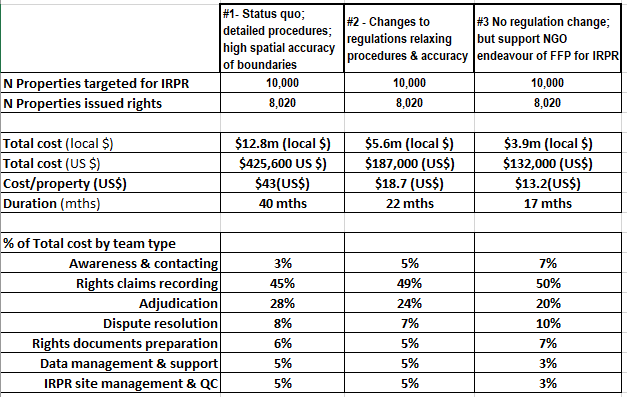
Some comments on the key highlighted values in Table 14.6.
- These should be regarded as orders of magnitude as that was the purpose of the model.
- Cost & duration- Option 1, status quo, is by far the most expensive, being over 3 times more expensive and time consuming than Option 3. Option 2 is half the cost and duration of Option1, but nearly 50% more costly and longer than Option 3.
- The main reasons for differences in cost & time - Option 1 has the lowest productivity and the highest unit costs for salaries and once off costs. This is due to existing regulations which require very high spatial accuracy and the use of certified property surveyors and notaries. This highly skilled expertise is limited.
- The cost per property (in US$) – Option 1, a largely western approach, is $43 and is similar to ~$50 reported from past aid projects using that approach. Option 3 , FFP largely undertaken by NGOs with some province support, costs slightly more than the $10 reported for FFP in the literature. Option 2, a FFP approach with the involvement of certified property professionals, is ~$19 which is about half of Option 1 and about 50% more than Option 3. As well as cost and duration, the advantages, disadvantages (Table 14.3), key issues (Sec 14.7.2), and risks (Table 14.8) of the various options need to be considered.
- Costs of training the teams are not included - These costs do not include those needed to establish and carry out training of the various teams before their deployment. This example deals with the detail to carry out IRPR at a single site. Typically, there would be a number of IRPR sites (say each of 10-20k properties) and a training facility would be established to train groups of teams. Also teams that finish at one site would be transferred to another site. Such a “roll out” will be examined in another example.
Other comments on Table 14.6.
- The number of properties identified as having no formal recorded property rights was estimated at 10,000 and that 8020 properties were formally issued with rights documentation for this single LR. The difference of nearly 2000 is due to assumptions made in the model for those that did not wish to participate in IRPR, property disputes that could not be resolved, and for properties that did not pay the required fee before being issued with registered rights documentation.
- The bottom part of the table provides a % breakdown of costs by team type for each option. It can be seen that Rights Claims Recording accounts for 45 to 50% of total cost, while Adjudication and Dispute Resolution can account for 30 to 35%. The rest of the team costs account for approximately 5%. A second pass of this model would produce some changes, but it is likely that the overall orders of magnitude would not change significantly.
14.6.2 Human resources required
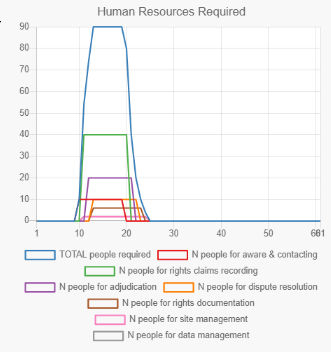
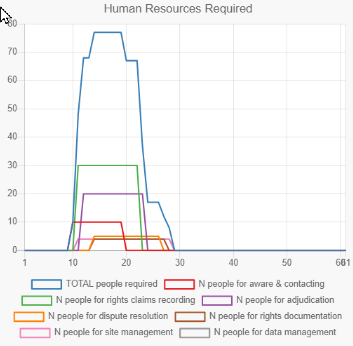
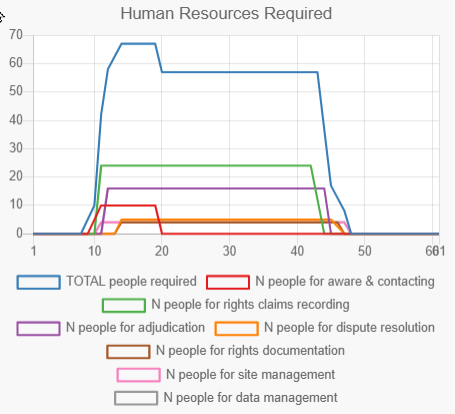
As well as having different durations and cost, each option will also have different requirements for human resources. Fig 14.7 shows the total human resources in total and by IRPR team type by time for each option. The majority of these will need training, especially for options 2 and 3.
Table 14.7 (shown in landscape in Annex K)
Option 1 Status Quo Option 2 FFP with regs changed Option 3 Assist NGOs with FFP
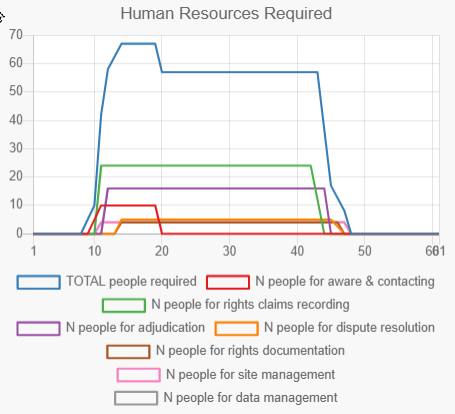
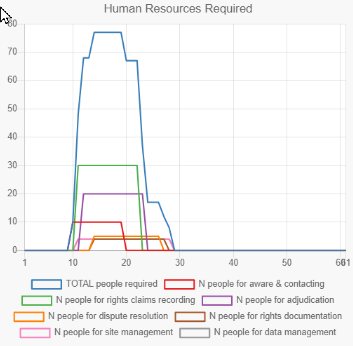
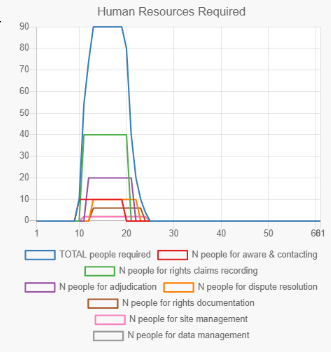
Comments on Table 14.7
Option 1
- A total of approximately 60 personnel are required for nearly the full duration of the project. Each team type requires a different numbers of personnel
- The greatest number of personnel are needed for Rights Claims Recording, because of the regulations, procedures to be followed and the high spatial accuracy required for boundaries. As noted previously, there are only limited numbers of property professionals and this largely dictates the duration of the project.
- In a 2nd pass of the model, some smoothing of team sizes could be done. e.g. fewer teams over a longer period for awareness and contacting.
Option 2
- A total of approximately 80 personnel are required for nearly the full duration of the project with different numbers for each team type.
- Compared to Option 1, the duration is much shorter and more are required for Rights Claims Recording and Adjudication.
Option 3
- A total of approximately 90 personnel are required for nearly the full duration of the project with different numbers for each team type.
- Option 3 has the shortest duration.
- Main Takeaways from the SD model and previous sections
- Option 2 for IRPR, using the FFP approach, and with the involvement of property professionals, was seen as the most advantageous option by the analysis team. (Sec 14.4.2 refers). However, it will require a change in regulations and the support and involvement of certified property surveyors and notaries. In terms of cost and time taken, Option 2 is roughly half the cost and duration of Option 1, but roughly 50% more that Option 3.
- Option 1, the status quo, is seen as not feasible because of high costs (~US$40-50/property) and the very long duration of ~3.5 years for 10,000 properties and a single LR, where the province need is ~60,000 properties over 6 LRs.
- Option 3, where the province provides some support to NGOs to carry out, while potentially feasible, is seen to have many disadvantages (Table 14.3 refers) and is not recommended by the analysis team.
- Whichever option is chosen, there are significant human resources requirements and there will be a need to build capability and capacity reasonably quickly, particularly for Options 2 and 3
- There are a number of key issues that need addressing (Sec 14.7 refers)
14.6.4 Model fitness for purpose and limitations
Model fitness for purpose
The analysis team was tasked by the SPOs to determine the order of magnitude of costs and durations for the IRPR options they identified. The logic, the SCS and the model was constructed as a first pass to determine the order of magnitude. The results shown in Table 14.6. The orders of magnitude for cost per parcel for the various options were in the ballpark of previously reported values. This provided a sanity check.
The model is thus considered as fit for purpose.
Model limitations
More time could be spent on refining aspects of the model and developing better estimates of productivity, unit costs, team size and start times ,etc. However the analysis team, felt that the law of diminishing returns would apply as the SPO’s brief was to determine the order of magnitude of costs and durations for the identified options.
14.7 Where the analysis is at; remaining task, identification of key issues
The analysis team were given three tasks by the SPOs (senior provincial officers) [Sec 14.1.1 refers]. They were tobetter understand:-
- The process of conducting IRPR; options for carrying out; advantages and disadvantages
- The magnitude of the task; likely duration, costs, resources to carry out;
- The key issues involved [e.g. impact on current operations, organisations, resources; necessity for aid; risks]
The analysis team considered they had completed tasks 1 and 2 and that only task 3 remained.
14.7.1 The key issues
In previous sections a number of key issues have been identified. In this section more are added, consolidated, and divided into strategic and operational issues. The operational ones relate to IRPR, while the strategic issues are those that will impact the operational issues.
Strategic issues
These were posed as questions for the SPOs and are:-
- What are the long-term aims3 of the province for the performance and quality of LA?
- Is IRPR to be regarded as a once off standalone activity, or to be considered in concert with how the technologies and processes of IRPR will interface with the existing or planned technology and systems, for the day-to-day operations of the LO’s and LR’s?
- Which IRPR option does the SPOs lean towards at this time?
- How is the endeavour, whether standalone IRPR or conducted in concert with day-to-day operational LA considerations, to be financed, and be financially sustainable in the long-term?
- How are the major risks to be addressed?
Operational issues
- The need for a detailed examination of others experience with the FFP approach to land administration and in conducting IRPR, to understand more fully, to ascertain lessons learnt, and to inform a suitable approach for the province
- To develop a short list of “possibly suitable” technology/tools for IRPR , and to also consider the interfaces with existing or planned technology systems for day-to-day operations in LOs/LR’s. Shortlisted technology/tools would need to be field tested for suitability
- How can operational capability and capacity (both in human resource numbers and know-how) to conduct IRPR be built quickly, particularly for Options 2 and 3 if selected
- The need to do a short quick IRPR field pilot once all issues have been resolved, and before proceeding to at scale province wide implementation. The field pilot would need to be preceded by detailed design supported by an updated SD model which could be verified during the conduct of the pilot, and used in the subsequent rollout.
14.7.2 Comments on each key issue by the analysis team
The analysis team’s comments on each key issue follow.
Strategic issues
#1-What are the long-term aimsof the province for the performance and quality of LA?
The option selected for IRPR will depend, in no small way, on the province’s long-term aims for the quality/performance of LA and LOs/LRs). It would seem that the province is committed to a rollout programme of improving and sustaining quality in all six of its LOs/LRs, and then to work with banks to have titles accepted by banks as collateral. If this is the case, then IRPR needs to result in quality rights documents lodged in the government LR and Option 2 is the most feasible. If the aim is to have more properties with some form of community rights documentation (rather than government issued), then Option 3 may be more appropriate. It would seem prudent for the provincial government to review and clearly state its long-term aims regarding quality/performance of LA, LOs/LRs and IRPR, and to widely disseminate its aims.
Recommendation: that the SPOs clearly state their long-term aims regarding quality/performance of LA, LOs/LRs, and IRPR and widely disseminate these aims.
#2-Is IRPR to be regarded as a once off standalone activity, or to be considered in concert with how the technologies and processes of IRPR will interface with the existing or planned technology and systems for the day-to-day operations of the LO’s and LR’s?
That while at scale IRPR is largely a once off activity it should be planned and executed with consideration of existing or planned systems in LOs/LRs to ensure maximum efficiency.
Recommendation: that IRPR be planned with consideration of existing or planned systems in LOs/LRs
#3-Which IRPR option dos the SPOs lean towards at this time?
The analysis team’s view is that Option 2 is the most feasible. However, the SPOs should provide an indication of their preference at this time, probably as a follow on from their decision on issue #1.
Recommendation:that the SPOs indicate their preferred IRPR option at this time
#4-How is the endeavour, whether standalone IRPR or conducted in concert with day-to-day operational LA considerations, to be financed, and be financially sustainable long-term?
This can be considered in two parts: (a) financing for the one-off large-scale IRPR, and (b) financing the maintenance of high quality in LOs/LRs
(a) financing for the one-off large-scale IRPR
Accessing aid is seen as having several advantages. It would enable IRPR for the 60,000 properties to be executed more quickly than the province trying to go it alone. Also, it would enable access to key personnel experienced in IRPR and FFP. An aid grant would be preferable, but if loan funding were necessary, a strong business case probably exists. This would need to be worked up, and probably should be in any case.
(b) financing the maintenance of high quality in LOs/LRs
Adding 60,000 properties to the registers in the LRs will increase the workload of LRs through increased land transactions. A high quality of LR operations needs to be attained and maintained to keep titleholders using the LRs. The example in Chapter 9 showed a way to self-finance and maintain high quality in LRs. If high quality cannot be sustained then, over time, the initial investment in large-scale IRPR will decay.
Recommendations:
- that aid be sought for IRPR, preferably as a grant
- that aid be sought for upgrading the quality of the six LRs, preferably as a grant
- that stable in country long-term self-financing be set in place before at scale so as to maintain high quality in LO/LR operations
#5-How are the major risks to be managed?
The major risks for IRPR mostly flow from the key issues identified. They are listed in Table 14.8 together with mitigation actions suggested by the analysis team.
Table 14.8
|
Risk |
Mitigation actions |
|
|
1 |
That the province will be unable to conduct IRPR via Option 2 & the FFP approach (the preferred option at this time) unless the regulations are changed. Achieving this change is seen as unlikely if it is opposed by the certified property surveyors and notaries who earn their living via Option 1, the status quo. |
Commence early discussions with “showstopper” stakeholders (such as property surveyors and notaries) with a view to how they might be involved and be supportive. |
|
2 |
That IRPR commences and, after some time ceases, and is unable to recommence. Some reasons could be:- planning time and cost estimates were too low and financing ceases; capacity building for staffing is inadequate; poor execution and management; lack of confidence by property rights holders in the probity of the IRPR process and broad unwillingness to be involved; stakeholder support decreases. |
|
|
3 |
That IRPR is successful in itself but the interface with LO/LR systems is poor, and parallel efforts to significantly increase the quality of LOs/LRs operations are not financially sustainable. That there is a slow loss in quality and reputation of LOs/LRs leading to titleholders not putting their transactions through the LR, leading to revenue losses. (The examples in Chapter 9 & 11 refer). The initial investment in IRPR is in danger of decaying over time. |
|
Recommendation: that the risk mitigation actions be accepted and acted on.
Operational issues
#1-The need for a detailed examination of others’ experiences with the FFP approach to land administration and in conducting IRPR, to understand more fully, to ascertain lessons learnt, and to inform a suitable approach for the province
Addressed in mitigation actions for Risk #2
#2-To develop a short list of “possibly suitable” technology/tools for IRPR , and to also consider the interfaces with existing or planned technology systems for day-to-day operations in LOs/LRs. Shortlisted technology/tools would need to be field tested for suitability
Addressed in mitigation actions for Risk #2
#3-How operational capability and capacity (both in human resource numbers and know-how) to conduct IRPR can be built quickly, particularly for Options 2 and 3, if selected.
Addressed in mitigation actions for Risk #2
#4-The need to do a short quick IRPR field pilot once all issues have been resolved, and before proceeding to at scale province wide implementation. The field pilot would need to be preceded by detailed design supported by an updated SD model which could be verified during the conduct of the pilot, and used in the subsequent rollout.
Addressed in mitigation actions for Risks #2 & 3
14.7.3 Suggested next steps and pointers for strategy for IRPR
Suggested next steps: That the recommendations listed in Sec 14.7.2 be accepted
Pointers for strategy for IRPR: While there are pointers to a strategy now, a strategy will become much clearer when the recommendations have been carried out and the results examined.
14.8 Results from a briefing to SPOs (senior provincial officials)
The analysis team used the material in this chapter to brief the SPOs who commissioned the work. The SPOs advised that they need some time to read and think, and that they would come back with a number of clarifying questions and for further discussions.
14.9 Other Points
14.9.1 Things that could be included in further passes of the model
A number of aspects that should be included in further passes of the model were provided in the risk mitigation actions (Table 14.8)
The “quality of project execution” and the impact that it could have on the level of rework required, and on time and cost could be included.
14.9.2 How this model or parts could be integrated with models from previous examples
One of the recommendations in Sec 14.7.2 was that the “planned” second pilot to increase quality in a LR [where quality is treated as having a number of subcomponents (example in Chapter 11 refers)], is completed and predominantly successful by the time the IRPR pilot is also completed. It was unstated but assumed, that a SD model would be built to guide implementation, be used for M&E, revised and used for the roll out to other LR. Such a model would involve integrating the models from the examples in Chapters 9, 11 and 12, as partially illustrated in Fig 11.7 of Chapter 11. To this could be added elements of Chapter 12 dealing with informal fees, Chapter 10 dealing with skills development, and Chapter 14 dealings with titles as collateral to raise development capital.
The structure of the model in Chapter 10 allowed for new titles via IRPR to be added as a flow to titleholders already in the LR. Such a structure would permit a close examination of the impact that a large number of new titles entering the system in a short period would have on the operations of a LR, including quality and financial.
14.10 Key Points
References
Burns T, K. Fairlie (2018), Framework for Costing and Financing Land Administrative Services, Report 3/2018, UN-Habitat/GLTN
Burns T, (2020), Land Administration Information and Transaction Systems: State of Practise and Decisions Tools for Future Investment, Millennium Challenge Corporation.
Enemark, S.; Bell, K.C.; Lemmen, C.; McLaren, R. (2014), Fit-for-Purpose Land Administration; FIG Publication No 60. Joint Publication; International Federation of Surveyors (FIG), and World Bank
Enemark, S.; McLaren, R.; Lemmen, C. (2016) Fit-for-Purpose Land Administration—Guiding Principles for Country Implementation; GLTN; UN-Habitat: Nairobi, Kenya
Enemark, S.; McLaren, R.; Lemmen, C. (2021), Fit-for-Purpose Land Administration—Providing Secure Land Rights at Scale. Land 2021, 10, 972. https://doi.org/10.3390/ land10090972
McLaren R, K. Fairlie, G. D’Souza (2018), New Technology and Emerging Trends: The State of Play for Land Administration; World Bank
ANNEX A
THE IRPR PROCESS CHAIN (Fig 14.3 in landscape)
ANNEX B
A generic Structure for Calculating the Work Capacity of IRPR Processing Teams
[Fig 14.4 enlarged]
ANNEX C
THE SKILLS DEVELOPMENT SCHEMATIC (Fig 10.3 in Chap 10)

Fig 10.3 shows-
A supply side comprised of
- Staff (in 2 categories of junior and senior)
- Skills (of staff) for each of the 2 cats of staff with a average skill for each staff category and an overall average skill level, with the effect that average skill level has on task capacity
- Salaries (of staff) for each of the two staff categories
- Task capacity (of staff), determined staff numbers, individual productivity, average skills level, and days worked
ANNEX D
A generic SCS for calculating the cost to establish and operate a IRPR processing team
[Fig 14.5 enlarged]
ANNEX E
Figs 14.4 & 5 combined
ANNEX F

Generic Team Structure
ANNEX G
Extracts and Comments re FFP from some Papers in the 2 Special Volumes of Land 2021, 10, 382
Becerra, L.; Molendijk, M.; Porras, N.; Spijkers, P.; Reydon, B.; Morales, J. Fit-For-Purpose Applications in Colombia: Defining Land Boundary Conflicts between Indigenous Sikuani and Neighbouring Settler Farmers. Land 2021, 10, 382. https://doi.org/ 10.3390/land10040382
Showing and discussing the results of rights claims recordings with all stakeholders helped to clarify the conflicts, to reduce the conflict to specific, relatively small, geographical areas, and to define concrete steps towards solutions
Biraro, M.; Zevenbergen, J.; Alemie, B.K. Good Practices in Updating Land Information Systems that Used Unconventional Approaches in Systematic Land Registration. Land 2021, 10, 437. https://doi.org/10.3390/land10040437
Process and systems for updating of land records need to be workable
Mekking, S.; Kougblenou, D.V.; Kossou, F.G. Fit-For-Purpose Upscaling Land Administration—A Case Study from Benin. Land 2021, 10, 440. https://doi.org/10.3390/ land10050440
A tenure system based on presumed ownership was introduced parallel with the existing title system with state guaranteed ownership. A shift in priorities from “good but slow” to good enough but fast”. The challenge was an estimated 5 million land parcels with less than 60,000 registered.
Bennett, R.M.; Unger, E.-M.; Lemmen, C.; Dijkstra, P. Land Administration Maintenance: A Review of the Persistent Problem and Emerging Fit-for-Purpose Solutions. Land 2021, 10, 509. https://doi.org/ 10.3390/land10050509
The fit-for-purpose era delivers a vast range of new social and technological innovations; however, scaled and sustainable implementations still struggle with system maintenance
Chigbu, U.E.; Bendzko, T.; Mabakeng, M.R.; Kuusaana, E.D.; Tutu, D.O. Fit-for-Purpose Land Administration from Theory to Practice: Three Demonstrative Case Studies of Local Land Administration Initiatives in Africa. Land 2021, 10, 476. https://doi.org/10.3390/ land10050476
The cases support the understanding that securing tenure does not require accurate surveys [25] (p. 19). this article demonstrates that using a mobile application (that operates on a single frequency GPS) by trained local people (especially youths and women) enables mapping exercises that minimize cost and still enhance the land tenure security of people
Antonio, D.; Njogu, S.; Nyamweru, H.; Gitau, J. Transforming Land Administration Practices through the Application of Fit-For-Purpose Technologies: Country Case Studies in Africa. Land 2021, 10, 538. https://doi.org/ 10.3390/land10050538
Citation: Koeva, M.; Humayun, M.I.; Timm, C.; Stöcker, C.; Crommelinck, S.; Chipofya, M.; Bennett, R.; Zevenbergen, J. Geospatial Tool and Geocloud Platform Innovations: A Fit-for-Purpose Land Administration Assessment. Land 2021, 10, 557. https://doi.org/10.3390/land10060557
There are combinations of tools, technologies, and platforms that have been used successfully
Musinguzi, M.; Enemark, S.; Mwesigye, S.P. Fit for Purpose Land Administration: Country Implementation Strategy for Addressing Uganda’s Land Tenure Security Problems. Land 2021, 10, 629. https://doi.org/10.3390/ land10060629
After 10 years of FFP pilots, Uganda is in advanced stages of developing a country wide strategy with interventions, time and cost estimation to transform the existing (western style) LA system to one based on FFP. Lessons learnt are drawn from three pilot case studies.
Kelm, K.; Antos, S.; McLaren, R. Applying the FFP Approach to Wider Land Management Functions. Land 2021, 10, 723. https://doi.org/10.3390/ land10070723
The paper discusses how individual land projects could be integrated into a more holistic land administration and management program approach and deliver a significant set of socio-economic benefits more quickly.
Approaches will require a significant cultural, professional, and institutional change from all stakeholders
Most land tenure programs simply focus on securing land rights for citizens, but this is just the start of their journey to leverage the economic potential of their land and property. For example, smallholder farmers (there are an estimated 500 million smallholder farmer families worldwide [68]) also require access to technical and financial services to improve their livelihoods. The incremental and fragmented delivery of these services makes their sustainable prosperity much more challenging. Therefore, an integrated package of technical and financial services, including security of tenure, would achieve much higher benefits from a portfolio of interventions. However, donors and Non-Governmental Organizations (NGOs) find this more holistic approach difficult to adopt due to their organizational divisions, silos of professional skills, difficulty in managing multi-faceted programs and complexity of interfacing with a range of recipient government ministries and departments. None of these current perceived restrictions are showstoppers, but adopting new approaches will require significant cultural and institutional change
Too often, land administration projects are provided with the capital budget to implement the project, but lack the revenue budgets, resources and processes for on-going maintenance of data underlying the services.
Panday, U.S.; Chhatkuli, R.R.; Joshi, J.R.; Deuja, J.; Antonio, D.; Enemark, S. Securing Land Rights for All through Fit-for-Purpose Land Administration Approach: The Case of Nepal. Land 2021, 10, 744. https:// doi.org/10.3390/land10070744
Two pilot studies using a participatory approach covering around 1500 and 3400 parcels, respectively, in an urban and a rural setting. The pilot studies were based on the FFPLA National Strategy and utilized satellite imageries and smartphones for identification and verification of land boundaries. Data collection to verification tasks were completed within seven months in the urban settlements and for an average cost of 7.5 USD per parcel; within the rural setting, the pilot study was also completed within 7 months and for an average cost of just over 3 USD per parcel. The studies also informed the discussions on building the legislative and institutional frameworks, which are now in place. With locally trained ‘grassroots surveyors’, the studies have provided a promising alternative to the conventional surveying technologies by providing a fast, inexpensive and acceptable solution. The tested approach may fulfill the commitment to resolve the countrywide mapping of informality. The use of consistent data model and mapping standards are recommended.
Nepal ~10million off registered land parcels. Completion of registering 10m parcels is 4-5 yrs using FFP. Time estimations do not include validation, revenue collection and final approvals.
There are cases of private sector led and public private partnerships (PPP) to support FFP
- Childress, M.; Carter, S.; Barki, E. Fit-for-Purpose, Private-Sector Led Land Regularization and Financing of Informal Settlements in Brazil. Land 2021, 10, 797. https://doi.org/ 10.3390/land10080797
- Todorovski, D.; Salazar, R.; Jacome, G. Assessment of Land Administration in Ecuador Based on the Fit-for-Purpose Approach. Land 2021, 10, 862. https://doi.org/ 10.3390/land10080862
ANNEX H
Notes on Content of Some Papers made by the Analysis Team
The analysis scanned the following documents, McLaren et al (2018), Burns et al (2018), Burns (2020), to get a feel for their contents and made some notes on the contents of each.
McLaren et al (2018)
This guide of ~180 pages responds to the opportunities of FFP LA by providing guidance of what new & emerging technologies could be effectively adopted. Sec 4.1Public awareness; 4.2 Background Info capture; 4.3 Capturing land rights in the field; 5.1 data management; 5.2 data access
This guide of ~180 pages is packed full of useful information on technologies, including they have been used for research, in a pilot or operational. There is also information on some areas where used, the cost of equipment, spatial accuracies typical achieved from certain technologies & total cost/parcel obtained. The skill level required for certain tasks is indicated.
Burns et al (2018)
CoFLAS is a set of guidelines in a tabular framework allows for exploring identifying and prioritising land administrative services (LAS) delivery options based on costs of development and running the service, financial resources available to pay for them as well as other considerations such as human capacity and strategic decisions like service coverage.
This guide comprises 4 Steps and a total of 39 guidance tables. Step 1 deals with Assessing the readiness for LAS reform. Step 2 Establishing LAS with broad geographic coverage. Step 3 Estimating the likely cost of ongoing LAS operation. Step 4 Estimating the likely revenue from LAS. It provides a very useful resource.
The guide does not directly provide productivity numbers (and is not intended to) pertinent to IRPR and the storyline of this example, however it indicates some unit costs and checklists of equipment.
Burns (2020)
This paper sets out strategic thinking in information and communication technology for land administration information and transaction systems. The primary focus of the work is to identify the factors to consider in assessing investment in the development and implementation of Land IT systems that provide a comprehensive system to register and record property rights and support for the processing of subsequent associated transactions. The core audience for this document is MCC (Millennium Challenge Corporation) land experts. Millennium Challenge Corporation. (2020).
While this paper does not deal with productivity for IRPR directly it provides much very useful information that needs careful consideration when considering investing in LA supporting Land IT systems. Particularly useful sections relevant to the story line of this example would be:- Sec 2, Learning from recent reform experience; Sec 3, unique challenges in low income/lower middle income countries; Sec 4.3, moving beyond traditional paper based land administration; Sec 5, Strategic decisions for Land IT system reform; Sec 6.1, planning for sustainability; Sec 6.2, Decisions and risks of investing in Land IT systems improvements.
ANNEX I
1st pass at number of team, team size and productivity for the different team types for each option
Numbers in red highlight changes between options
|
Team & Aspect |
#1- Status quo; detailed procedures; high spatial accuracy of boundaries |
#2 - Changes to regulations relaxing procedures & accuracy |
#3 Not change regulations but support NGO endeavour of FFP for IRPR |
|
Contacting Teams |
|||
|
N teams |
10 |
10 |
10 |
|
Productivity (/team/day) |
4 |
4 |
4 |
|
People/team |
1 |
1 |
1 |
|
Mth team starts |
8 |
8 |
8 |
|
Rights Claims Recording Teams |
|||
|
N teams |
8 |
15 |
20 |
|
Productivity (/team/day) |
1 |
2 |
2 |
|
People/team |
3 |
2 |
2 |
|
Mth team starts |
9 |
9 |
9 |
|
Adjudication Teams |
|||
|
N teams |
8 |
10 |
10 |
|
Productivity (/team/day) |
4 |
6 |
10 |
|
People/team |
2 |
2 |
2 |
|
Mth team starts |
10 |
10 |
10 |
|
Dispute Resolution Teams |
|||
|
N teams |
5 |
5 |
10 |
|
Productivity (/team/day) |
0.25 |
0.5 |
0.5 |
|
People/team |
2 |
2 |
1 |
|
Mth team starts |
12 |
12 |
11 |
|
Rights Documentation Teams |
|||
|
N teams |
6 |
6 |
6 |
|
Productivity (/team/day) |
4 |
4 |
6 |
|
People/team |
2 |
2 |
1 |
|
Mth team starts |
12 |
12 |
11 |
|
Data Management & Support Team |
|||
|
N teams |
1 |
1 |
1 |
|
People/team |
4 |
4 |
2 |
|
Mth team starts |
8 |
8 |
8 |
|
IPRR site management Team |
|||
|
N teams |
1 |
1 |
1 |
|
People/team |
4 |
4 |
2 |
|
Mth team starts |
8 |
8 |
8 |
ANNEX J
A 1st pass at unit costs to establish and operate the teams for the different team types for each option
Numbers in red highlight changes between options. All costs are in local $s.
|
Team & Aspect |
#1- Status quo; detailed procedures; high spatial accuracy of boundaries |
#2 - Changes to regulations relaxing procedures & accuracy |
#3 Not change regulations but support NGO endeavour of FFP for IRPR |
|
Contacting Teams |
|||
|
individual salary (/pers/mth |
2200 |
2200 |
2200 |
|
O&M ($/team/mth |
500 |
500 |
500 |
|
Once off costs ($/team |
1000 |
1000 |
1000 |
|
Social media ($/mth) |
1000 |
1000 |
500 |
|
Rights Claims Recording Teams |
|||
|
individual salary (/pers/mth |
5500 |
4400 |
3850 |
|
O&M ($/team/mth |
1500 |
1500 |
1000 |
|
Once off costs ($/team |
5000 |
5000 |
5000 |
|
Social media ($/mth) |
1000 |
1000 |
500 |
|
Adjudication Teams |
|||
|
individual salary (/pers/mth |
5500 |
4400 |
3300 |
|
O&M ($/team/mth |
1500 |
1500 |
1000 |
|
Once off costs ($/team |
1000 |
1000 |
1000 |
|
Social media ($/mth) |
1000 |
1000 |
500 |
|
Dispute Resolution Teams |
|||
|
individual salary (/pers/mth |
5500 |
4400 |
3850 |
|
O&M ($/team/mth |
800 |
800 |
300 |
|
Once off costs ($/team |
1000 |
1000 |
300 |
|
Social media ($/mth) |
500 |
500 |
0 |
|
Rights Documentation Teams |
|||
|
Individual salary (/pers/mth |
6000 |
3500 |
2200 |
|
O&M ($/team/mth |
800 |
800 |
200 |
|
Once off costs ($/team |
1000 |
1000 |
200 |
|
Social media ($/mth) |
1000 |
1000 |
0 |
|
Data Management & Support Team |
|||
|
Individual salary (/pers/mth |
3500 |
3500 |
3500 |
|
O&M ($/team/mth |
1000 |
1000 |
1000 |
|
Once off costs ($/team |
5000 |
5000 |
5000 |
|
Social media ($/mth) |
0 |
0 |
0 |
|
IRPR Site management & QC team |
|||
|
Individual salary (/pers/mth |
3500 |
3500 |
3500 |
|
O&M ($/team/mth |
1000 |
1000 |
1000 |
|
Once off costs ($/team |
5000 |
5000 |
5000 |
|
Social media ($/mth) |
0 |
0 |
0 |
ANNEX K
Human resources needed for each IRPR option, in total and by team type; Fig 14.7 in landscape
ANNEX K
Abbreviations Used
|
CBA |
Cost Benefit analysis |
|
FFP |
Fit for purpose |
|
IC |
In country |
|
IRPR |
Initial recording of property rights |
|
LA |
Land administration |
|
LO |
Land Office |
|
LR |
Land registry |
|
NGO |
Non government organisation |
|
O&M |
Operations and maintenance |
|
PGov |
Provincial Government |
|
PIO |
Performance improvement objective |
|
PIP |
Proposal to improve performance |
|
PLO |
Provincial land office |
|
POT |
Performance over time |
|
PPP |
Public private partnership |
|
RGL |
Registry of Government Land |
|
QC |
Quality control |
|
SCS |
Schematic of the core structure |
|
SD |
Strategy dynamics |
|
SPO |
Senior provincial official |
Footnotes
- 1 IRPR can also be called tenure formalization or securing property rights ↩
- 2 The publication, kadaster (2020), Fit-For-Purpose Land Administration for All, A guide for surveyors on adoption and adaption Fit-For-Purpose Land Administration, authors E Ungar, R Bennett, is specifically addressed to surveyors ↩
- 3 the vital need for clarity of the aim was discussed in Chapter 11 Sec 11.6.2 when dealing with increasing quality, where quality was treated as being composed of a number of subcomponents ↩