
Improve Land Administration
in Developing Countries
by USING SIMULATION & STRATEGY DYNAMICS
to TEST PROPOSED IMPROVEMENTS
for effectivnes & sustainability
BEFORE MAKING THE DECISION TO INVEST.
Common Questions About Simulation & Strategy Dynamics

Strategy Dynamics provides a practical way to TEST proposed Land Administration improvements BEFORE major investment decisions are made. These common questions explain how simulation works, how it supports better planning, and why it can help improve the long-term success of Development Assistance projects.
Common Questions
WHAT is Simulation and Strategy Dynamics?
Simulation is using computer models to represent a real world process/ system. Strategy Dynamics (SD) is a simulation method, with a focus on improving the performance of a system.
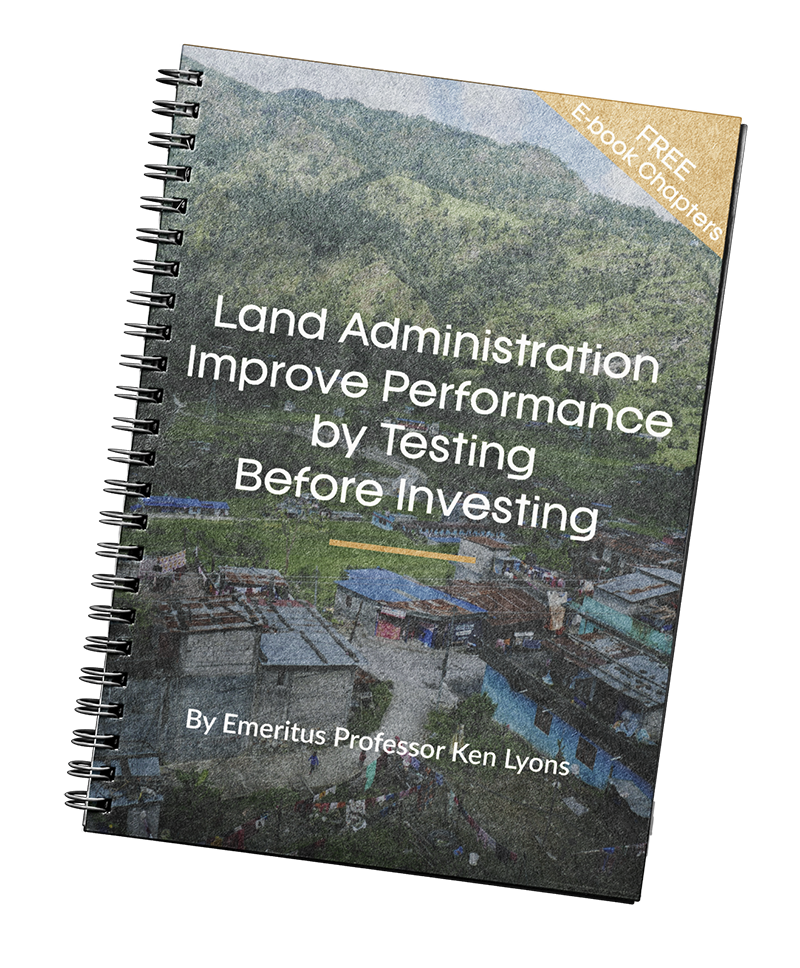
This E-Book focuses on how to use SD to improve the performance of the system of land administration (LA) in developing economies. SD is based on system dynamics developed at MIT in the 1960s and used widely. SD was developed initially to make system dynamics more accessible to business executives. SD was developed by Dr Kim Warren of Strategy Dynamics. www.strategydynamics.com
WHY is it important to improve Land Administration (LA) in Developing Economies?
Secure and enforceable land/ property rights are fundamental to social stability and economic development. Secure property rights depend on effective Land Administration (Land Admin) (LA), the system of policies, laws, organisations, and services. If LA is weak, property rights are likely to be weak.
In developed economies the following features largely exist in LA:- secure and enforceable property rights over all geographic areas; relatively few land disputes or violent demonstrations; an active well-regulated land market; extensive amounts of development capital raised using land/property as collateral.
In developing economies many features do not exist. If they do, it is often only partially, in limited geographic areas, or for certain groups, generally those who can afford to access it.
International Development Assistance (IDA) has been provided over decades to improve the LA system. While there have been success, widespread success remains elusive.
A serious challenge is sustainability of improvements, after IDA funding ceases, and where a country has to provide internal funding to maintain the improvements, long term.
The simulation method of Strategy Dynamics (SD) is a practical way, (a new tool in the LA toolbox), to quantitatively test the effectiveness and long-term sustainability of improvements proposals, BFORE committing substantial financial resources.
HOW is Strategy Dynamics (SD) used to Improve Land Administration (LA) in Developing Economies?
The SD approach allows time based, quantified and transparent simulation models to be built showing how organisations perform over time. This makes it possible to work out what to do on all key decisions (e.g. wanting to improve a part of the Land Admin (LA) system - across a business, and to continually update those insights as circumstances change(e.g. during the implementation of an improvement project).
Many parts of the land admin (LA) system are essentially government owned business that charge fees for services). e.g. Land Registry, Property Tax, Land Zoning, Development Approvals.
Strategy Dynamics (SD) enables [Dr Kim Warren the developer of SD]: – #1The determination if a plan will work at all; #2 The design of a system so that it can perform well; #3 The management of a system so that it does perform well; #4 The fixing of a system if problems occur
Scenarios for Performance Improvement Proposals (PIP) can be set up and TESTED for Effectiveness & Sustainability BEFORE making the investment decision.
WHAT is the Value Proposition in using Strategy Dynamics (SD) to Improve Land Administration (LA) in Developing Economies?
Common current approaches are the Logframe and Theory of Change. Both are qualitative and can have implicit assumptions.
SD adds considerable value by:-
- Being quantitative; having no implicit assumptions; handling indirect cause and effect via feedback loops
- Having the development logic (what is causing what- The WHY) fully explicit in the SD (simulation) model
- Enhancing stakeholder buy in by:- showing WHAT is to happen, HOW, by WHEN; testing stakeholders’ improvement proposals and What Ifs with them in a workshop setting.
- Extending timeframes past the period of Development Assistance (DA), and examining how sustainability post DA might be achieved over many years
- Containing all aspects in a single model; any change is immediately reflected throughout.
- Being able to use SD models in:- feasibility; design; project appraisal; M&E and testing modifications; reviews; checking and adjusting for sustainability.
- Models are easily modified and components can be reused in new situations.
- Being able to incorporate the pathways of FELA (Framework for Effective LA) and FFPLA (Fit for Purpose Land Administration)
- (with training) SD provides the capability for Land Agencies and Finance Departments in developing countries & NGOs (Non-Government Organisation) to:- test their own “improvement” ideas for effectiveness and sustainability; work with in country stakeholders to achieve “buy in”; build a business case to approach a DA (development assistance) partner.
What is the main take away from the illustrative examples of using Strategy Dynamics (SD) to improve Land Admin (LA) in the E-Book Chapters?
The main take away point Is NOT the results or numbers from any particular example BUT IS the utility of the SD approach itself.
The SD approach provides the means for anyone to:-
- Identify desired Performance Improvement Objectives (PIOs)
- Illustrate past and future desired and feared performances, using Performance Over Time (POT) graphs for each PIO
- Identify the System where performance is to be improved
- Build an SD simulation model of the system to be improved, portraying:- the development /improvement logic; the proposed improvements/scenarios;
- TEST proposals for SUCCESS [ ie for ACHIEVEMENT of improvement targets (the desired future), with aid, and SUSTAINABILITY of improvements post aid , when reliant solely reliant on in-country budgets]
- Reiterate and modify as necessary:- include risk analysis; What Ifs; project evaluation with financials
This provides the means for anyone to:-
- Rework an analysis with different perception(s) of a situation where improvements are considered necessary (this can be valuable when some stakeholders/gatekeepers disagree, and agreement is necessary on What constitutes SUCCESS and How it will be achieved, so that incountry finance and aid funding will be approved)
- Rework or extend any of the illustrative examples
- Apply the SD approach to any aspect in the Land Admin (LA) system
Others use Simulation, WHY NOT use in Land Administration?
Simulation is used operationally in many areas in developed economies, and in some instances for developing economies. WHY NOT trail simulation operationally to Improve Land Admin (LA) with Development Assistance funding?
Is Land Admin so different to other areas that Simulation is not applicable?
IF SO, WHY is SIMULATION NOT APPLICABLE to LAND ADMIN?
Meet the Author

Ken Lyons
Dr Ken Lyons
Emeritus Professor and Retired Land Administration Practitioner
Dr Ken Lyons has had a long and varied career across land administration, surveying, mapping, GIS, academia, consulting and development assistance.
In later years, he spent more than 20 years working on land administration development projects in a variety of roles, including technical project director, design team leader, monitoring mission member and technical advisor. His work has included projects across the South Pacific, South-East Asia, the Philippines, India, Africa and China.
Ken holds Bachelor, Master and PhD degrees. He is an Emeritus Professor of the University of Queensland, where he was Head of the Geographical Sciences Department and founded the Australian Key Centre in Land Information Studies.
After leaving academia, Ken led his own consulting company for 30 years, working across government, industry, land and mapping agencies, natural resource management, emergency services and development projects.
Contact the author
Make The Aid Investment SUSTAINABLE, post Aid.
TEST Proposed Improvements for SUCCESS, BEFORE Investing.
SUCCESS is considered to be
- ACHIEVING design targets with AID
- SUSTAINING improvements, post AID for long periods, using in country financing.