
CHAPTER 3
DEVELOPMENT LOGIC and WHERE THE “SYSTEM” of LAND ADMINISTRATION FITS in 3.0 Introduction 3.1 Common ways of showing development logic 3.1.1 The Logframe 3.1.2 The Theory of Change 3.2 Assumptions (Explicit and Implicit) in LA Projects 3.3 Indicative Inputs, Activities, Outputs, Major Assumptions & Outcomes for each LA Operational Entity 3.4 Where the “System” of LA fits into the development logic of the logframe 3.6 Key Points Tables 3.1 Some characteristics, examples, and consequences of a “system” 3.2 An illustrative logframe for the IDA task of removing a backlog in the LR and keeping it low Figures 3.1 Example of a logframe template 3.2a Another representation of the development logic 3.2b A high level example from Land Administration 3.3 Where the “system” of LA “fits” into the development logic of the logframe. 3.4 Illustrating feedback loops within the system & between outputs, the system, outcomes and impacts. Annexes A Example of part of a logframe for a LA IDA project B Example of part of a Theory of Change diagram C Shows many of the (implicit) assumptions underlying the development logic D Illustrative examples of inputs, activities, outputs, outcomes, impacts and major assumptions for each LA operational entity. Parts that comprise Annex D-
- A - First Recording of Private Land/Property Rights (FRR) into a Government Land Registry (LR)
- B1 -Improve the operations of an LR
- B2 - Develop an LIS (land Information System)
- C - Implement/ improve a LVTS (land valuation & land tax system)
- D - Implement/improve a LURMS (Land Use Regulatory and Management System)
- E - Implement/ improve a MIS (Municipal Information System)
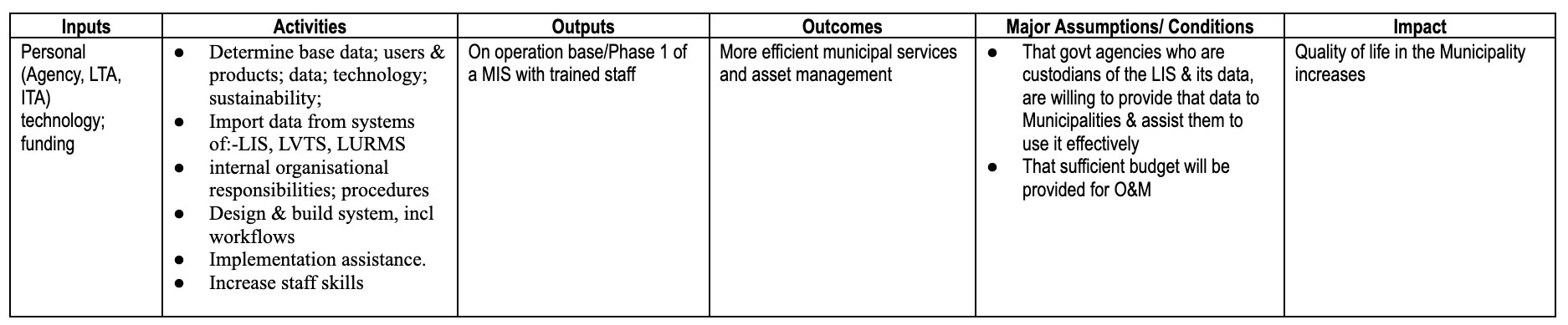
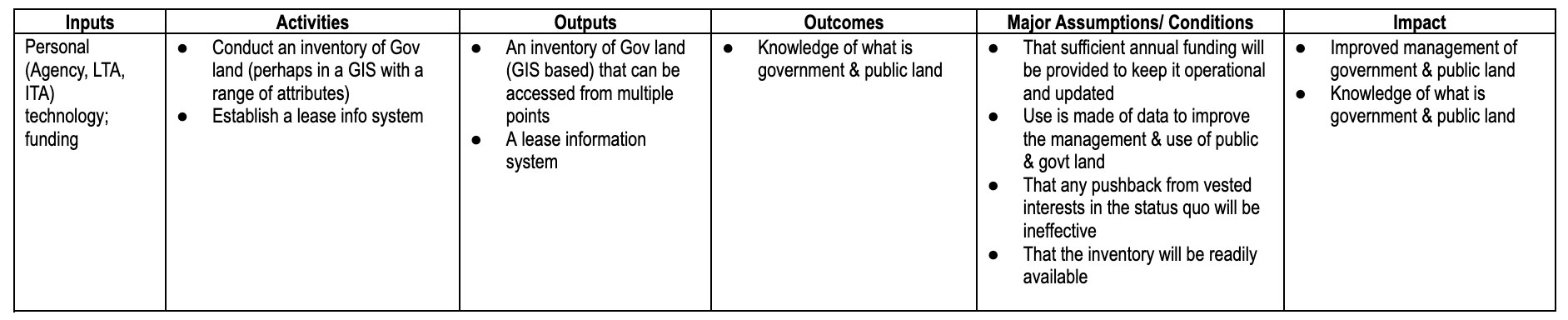
- F1 - Implement/improve a RGL (Registry of Government land)
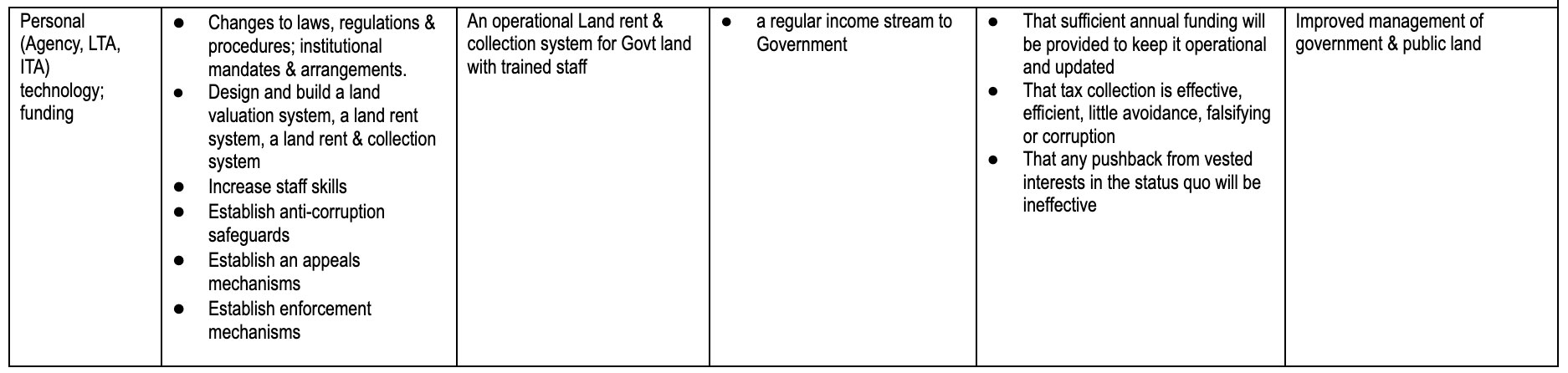
- F2 - Implement/ improve LVRS (land valuation, land & land rent system (for Government Land))
- E - Abbreviations used
CHAPTER 3
DEVELOPMENT LOGIC and WHERE THE “SYSTEM” of LAND ADMINISTRATION FITS in 3.0 Introduction In Chapter 2 it was noted that there are a number of operational entities in LA (land administration) and that IDA (international development assistance) has been provided to improve particular aspects in most LA operational entities. The purpose of this chapter is to: -
- Briefly indicate the common way of showing development logic
- Show typical examples of activities, outputs, outcomes, impacts, and assumptions for each of the operational LA entities
- Indicate where the “system” of LA fits into IDA project development logic, and the characteristics and consequences of including the LA “system” into the development logic
- To introduce feedback loops
It is not the purpose of this chapter to provide an in depth treatment of development logic as much literature exists. 3.1 Common ways of showing development logic Two common ways of showing development logic are the Logframe (logical framework matrix), and the Theory of Change.
3.1.1 The Logframe
Many IDA donors and development banks use the logframe as part of the design process and project documentation. Jensen (2013) provides an easy to read guide. A logframe concisely summarises: - inputs into a project (human, financial etc.); activities to be undertaken; results expected and how measured; assumptions made. Jensen (2013) provides an example of a logframe template as shown in Figure 3.1. Figure 3.1 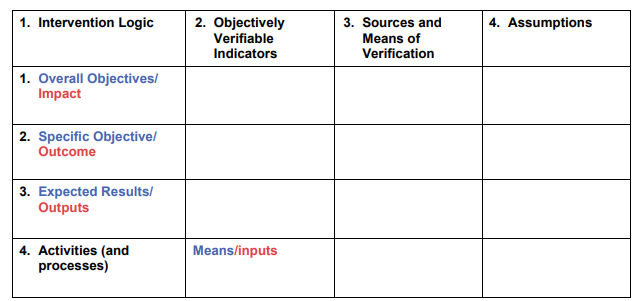 Red shows UK (DFID) terminology, while blue is that of EC. Figure 3.2a shows another representation of the development logic (Warren K (2017)), and in Figure 3.2b examples of inputs, outputs etc., for LA administration by the author. Figure 3.2a
 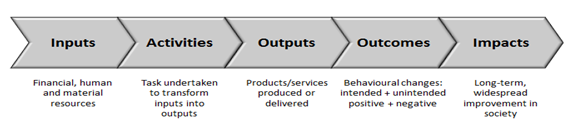 Figure 3.2b A high level example from Land Administration
| Inputs | Activities | Outputs | Outcomes | Impacts |
|---|---|---|---|---|
|
|
|
|
|
The logframe provides a linear view of cause and effect. e.g.
- The input of funding allows the designated activities of land rights recording to be undertaken
- The activities result in achievement of the design outputs, a significant increase in registered land/property and improved operation of the LR
- The outputs in turn cause the outcomes of increase in tenure security and more land transaction recorded in the LR
- The outcomes bring about the impacts of reduced land disputes and increased investment in land
Inputs, activities and outputs fall within the time frame of the project and rely heavily on the IDA funding and technical development assistance. Outcomes are hopefully apparent 5- 10 years after project completion while impacts may be 10-20 years later. Sustainability of benefits post an IDA project period is generally entirely dependent on local agency funding to maintain and build on the project outputs, to achieve the longer term outcomes and impacts aimed for in the logframe. An example of a logframe for an LA IDA project is shown at Annex A. Assumptions are discussed in Sec 3.3.
3.1.2 The Theory of Change
Another way to depict the development logic of an IDA project is by way of a Theory of Change diagram and description. An example of the theory of change approach applied to a LA Project is shown at Annex B., It has a row based structure of: -
- Context - a description of items of concern
- Interventions - proposed high level interventions to address the items of concern
- Changes in actions/attitudes- that are anticipated to be achieved
- Outputs, that the interventions are planned to be achieved with IDA
- Outcomes - result from the outputs
- Impacts - changes that are hoped to occur postIDA, as a result of the outputs and outcomes
The differences between a Logframe and a Theory of Change diagram is briefly outlined at Tools 4 development (accessed June 2018), and Ann-Murray Brown Consultancy (accessed June 2018) and is summarized below. See also DFID (2012). Differences between a Logframe & Theory of Change
- In essence both represent a “hypothesis of change”.
- A Logframe indicates “by doing X (activities), Y (output) will be produced. It portrays cause and effect. as linear
- A Theory of Change indicates “doing X will produce a change in Y because …” It can portray cause and effect as nonlinear via feedback loops and describes them descriptively.
Feedback loops allow nonlinear cause and effect to be taken into account. The use of feedback loops is the characteristic that makes the SD (system dynamics) approach unique. Feedback loops in the LA “system” are introduced in Section 3.4 and covered more in Chapter 4. A powerful feature of Warren’s SD approach and the associated Silico modelling software is that it incorporates feedback loops and provides for nonlinear cause and effect, and is quantitative and transparent with no implicit assumptions (illustrated fully in later chapters), whereas the logframe and Theory of Change are largely descriptive, non quantitative, and there can be many implicit assumptions. This provides the ability for the SD approach to add value to the Logfame and the Theory of Change (Chap 9 refers). A recent report, GLTN (2020) discusses the theory of change/logic model in the context of impact evaluation.
3.2 Assumptions (Explicit and Implicit) in LA Projects
Many assumptions are made in development logic. The ones that are explicit are listed in the assumption’s column of the logframe. Space generally only permits the main assumptions to be explicit and shown in a logframe, and many other assumptions can remain unstated and implicit. The high level development logic for LA projects is generally along the following lines:- A title1 gives landholders formal rights and security to their land; Security of title reduces land disputes (fosters social stability); The title gives access to (better/more) credit, and access to formal market by using the title as collateral (increases economic development). Annex C shows many of the assumptions underlying the development logic (AusAid 2000). The headings in bold would tend to be explicit and in a logframe, while the dot points under each bold heading would tend to be the unstated implicit assumptions. In the SD approach all assumptions are explicitly and transparently shown. Assumptions can also be thought of as conditions that need to be met so that the outcomes can be achieved.
3.3 Indicative Inputs, Activities, Outputs, Major Assumptions & Outcomes for each LA Operational Entity
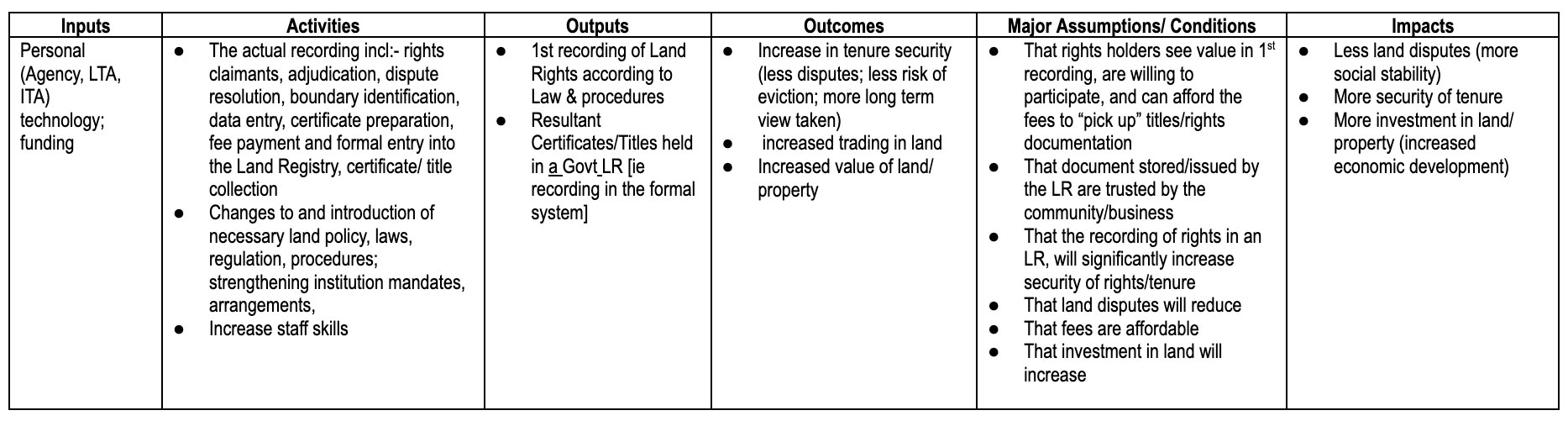
Figure 3.2b showed, at a high level, some illustrative examples of inputs, activities, outputs, outcomes, and impacts for LA. The implicit assumptions in Annex C are for LA as a whole. In Chapter 2 Figure 2.2 LA was shown as composed of a number of operational entities. Annex D of Chapter 2 showed types of IDA that have typically been provided to improve individual operational entities. Annex D of this Chapter provides illustrative examples of inputs, activities, outputs, outcomes, impacts and major assumptions for each LA operational entity. Annex D is composed of a number of parts, one for each LA operational entity. They are: -
- A - First Recording of Private Land/Property Rights (FRR) into a Government Land Registry (LR)
- B1 -Improve the operations of an LR
- B2 - Develop an LIS (land Information System)
- C - Implement/ improve a LVTS (land valuation & land tax system)
- D - Implement/improve a LURMS (Land Use Regulatory and Management System)
- E - Implement/ improve a MIS (Municipal Information System)
- F1 - Implement/improve a RGL (Registry of Government land)
- F2 - Implement/ improve LVRS (land valuation, land & land rent system (for Government Land))
The purpose of Annex D is to show that for each operational entity there are quite different activities, outputs, outcomes, assumptions and impacts. A scan of Annex D indicates the range and complexity of tasks that can be involved in seeking to improve all or particular aspects in LA. To this can be added, the magnitude of the development gap that might need to be closed (Chap 2, Figure 2.1, Annexes B & C refer), and the geographic areas to be covered (e.g. millions of parcels of land may need initial rights recorded; existing LRs may hold millions of records whose veracity and currency may need upgrading). A perusal of the assumptions, (many typically implicit), indicates that many are not minor conditions, and should be taken into account and addressed in the design. Adding in the need to foster sustainability, then combined, these can give rise to large and complex IDA LA projects. Also included there will normally be a range of supporting activities which support the main outputs shown in Annex D. e.g. baseline studies, gender studies. The aim in Annex D has been to illustrate “bare bones”. The above refers to large and costly IDA projects. At the other end of the scale, a small IDA could be assistance to “remove a processing backlog in the LR and put in place measures to keep the processing backlog very low post IDA”. This IDA is a single task shown in Annex D Part B1. This will be used as the first illustrative use of the SD approach and is covered in Chapters 4 to 7. Other chapters illustrate the use of SD for other Parts of Annex D. The next section looks at where LA as a “system” fits into the development logic and the effect of feedback loops.
3.4 Where the “System” of LA fits into the development logic of the logframe
Figure 3.2a, b (Sec 3.2.1) illustrated a linear view of the development logic of the logframe. Sec 3.2.2 indicated that the Theory of Change description can describe nonlinear behaviour and feedback loops which are characteristics of “systems” behaviour in the SD approach. Figure 3.3 shows where the “system” of LA “fits” into the development logic of the logframe. Figure 3.3 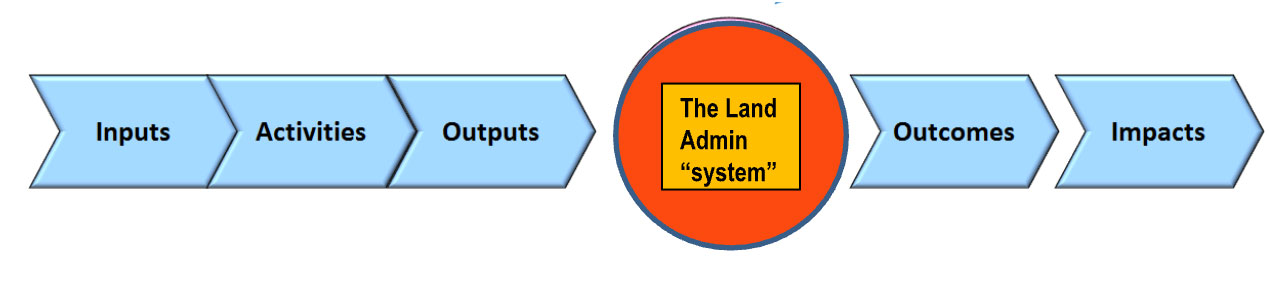 Outcomes reflect how the “system” responds to the Outputs arising from inputs and activities Some characteristics, examples, and consequences of a “system” are shown in Table 3.1. Figures 3.2 and 3.3, and Table 3.1 follow closely that used by Warren (2013a) when applying the SD approach to Nigeria’s DFID Aid for trade, and Warren (2013b) when applying SD to Nepal’s sectors of tourism, power, roads and agriculture, Table 3.1 Characteristics, examples, and consequences of a “system”
| Characteristics | Examples | Consequences |
|---|---|---|
| Accumulation Critical factors build up or deplete over time. |
|
Long delays can occur between action and results. Things can get worse before they get better. For example, it can take time after IRPR for titleholders to have sufficient trust in the LR to process their land dealings through the LR. |
| Interdependence Change depends on more than one factor. Multiple choices need to be right across multiple issues. | The following are all needed for titleholders to use the LR for all land dealings:
|
Intervention may have no apparent impact. For example, bringing a lot of land onto the register may make little difference if titleholders have little trust in the LR and do not register subsequent land dealings through the LR. |
| Feedback Interdependence causes changes that either accelerate or brake their own progress. Many feedback mechanisms can exist. | Growth in the number of titleholders encourages increased land dealings, but lack of trust in the LR and the collection of informal fees can discourage titleholders from using the LR. | The “system” can “resist” efforts to improve its performance. For example, significant investment in IRPR and improving the performance of the LR will decay over time if a percentage of land dealings are done outside the LR. Confidence in the LR will fall, security of tenure will decrease over time, land disputes are likely to increase, and social stability may decrease. |
| Thresholds The system is unresponsive to change over a wide range, then switches to a new mode. | Titleholders are not attracted to use the LR until they have a certain high level of trust in the integrity of the LR, including its records and operations, and informal fees are infrequent. | Apparent failure of interventions while moving to the tipping point. For example, dealings through the LR do not increase significantly until trust in the LR increases and reaches a certain high level. |
The SD approach deals explicitly with all of these characteristics in a quantitative and transparent manner. This will be illustrated progressively in subsequent chapters. Figure 3.4 is an enhanced version of part of Figure 3.3 illustrating feedback loops within the system & between outputs, the system, outcomes and impacts. Feedback loops are illustrated in most of the following chapters. Figure 3.4 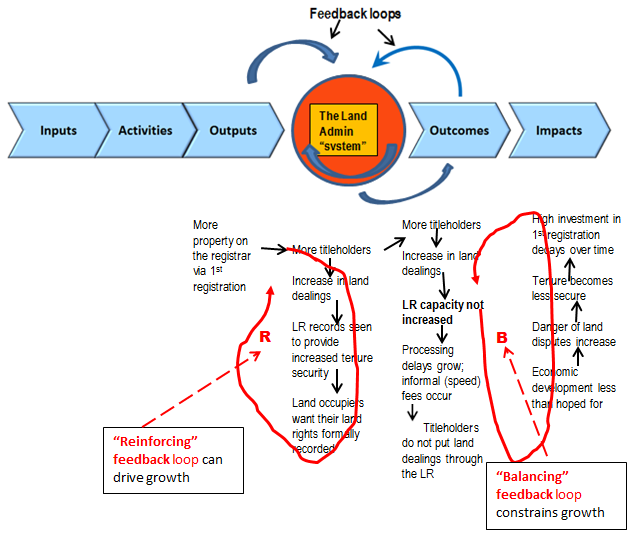 The Reinforcing feedback loop This is reinforcing (or +ve) feedback loop and drives growth. viz. as more land is registered, there are more land dealings, tenure security is seen to have been increased, this increases land dealings and LR operations, which in turn leads to more land dealing, and more landowners willing to register their land. The Balancing feedback loop This is a balancing (or –ve) feedback loop which constrains growth. viz as more land is registered, there are more land dealings, BUT if processing capacity in the LR is not increased to deal with the increase, there will be increasing processing delays, “speed” fees may be paid to “jump the queue”; title holders could well conduct land dealings outside the LR. These overtime will cause a loss of confidence in the operations of the LR, a decrease in tenure security, and a loss in the high investment of first registration. The SD approach deals explicitly, numerically and transparently with feedback loops as is illustrated progressively in subsequent chapters. The next chapter introduces SD and its principle, and applies then to the first illustrative example in LA, that of removing the backlog in a LR (land registry) and keeping it low, post IDA.
3.5 Key Points
- The logframe and the theory of change are common ways of showing IDA development logic. The logframe depicts linear cause and effect, while the theory of change can describe nonlinear cause and effect by using feedback loops. Many assumptions are made in development logic, and many are implicit and not minor. Both are descriptive methods.
- The “system” of LA fits between outputs and outcomes in the development logic. Systems have characteristics of accumulation, interdependence, feedback and thresholds which affect the achievement of outputs, outcomes and impacts.
- Simulation, using the Strategy Dynamics (SD) Approach, allows “the System of LA” to be taken into account. It is quantitative, transparent, and all assumptions are explicit. It adds value to the Logframe and the Theory of Change.
References
Ann-Murray Brown Consultancy (accessed June 2018). https://www.annmurraybrown.com/single-post/2016/03/20/Theory-of-Change-vsThe-Logic-Model-Never-Be-Confused-Again AusAID (2000), Improving Access to Land and Enhancing The Security of Land Rights: A Review of Land Titling and Land Administration Projects, Quality Assurance Series No. 20 September 2000. DFID (2012), Review of the use of “Theory of Change” in international development. Review report by I Vogel GLTN (2020), The “How To: Guide for Integrating Impact Evaluation into Programming. https://gltn.net/2021/01/13/the-how-to-guide-for-integration-of-impact-evaluation-into-programming/ Jensen G (2013) The logical framework approach; https://www.bond.org.uk/data/files/resources/49/The-logical-framework-approach-How-To-guide-December-2013.pdf Tools 4 development (accessed Jun 2018) http://www.tools4dev.org/resources/theory-of-change-vs-logical-framework-whats-the-difference-in-practice/ Warren K (2009), Strategic Management Dynamics, John Wiley & Sons Ltd Warren K (2013a), DFID Aid for Trade https://www.youtube.com/watchv=QlM3O0JBFTo&list=PL7cF528k5MjTe9ca7X3vxbMlI3brauenD Warren K (2013b), DFID Nepal PSD program; applying system dynamics to Nepal’s sectors of tourism, power, roads and agriculture; Personal Communication
ANNEX A
Part of the Logical Framework for the Panama Land Administration and Regularization Project PN-0148 Loan Proposal; Document of the Inter-American Development Bank http://citeseerx.ist.psu.edu/viewdoc/download?doi=10.1.1.198.683&rep=rep1&type=pdf (accessed 7Feb19) 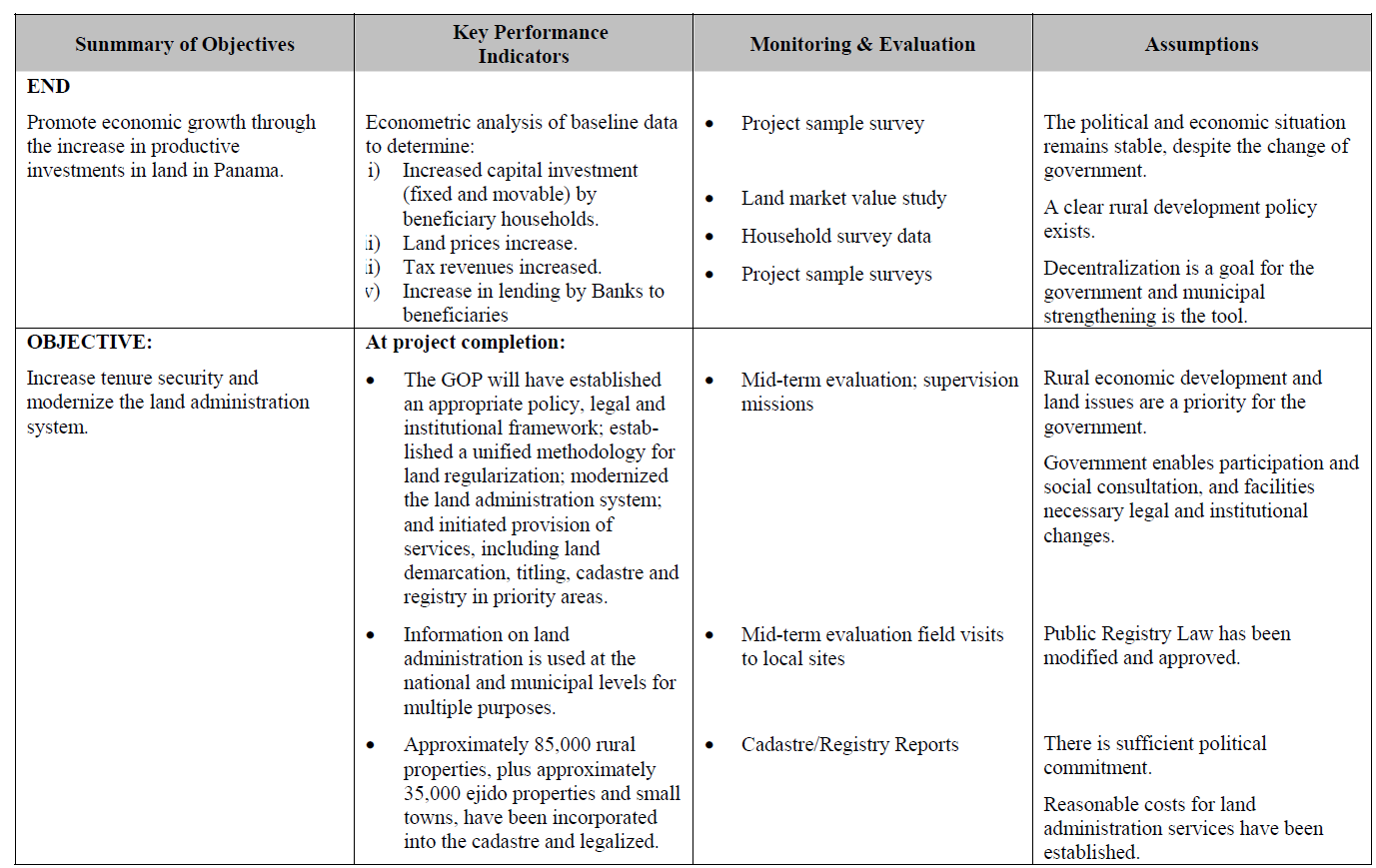
ANNEX B
Example of a Theory of Change Diagram for a Land Admin Project DFID (~2013) Business case and Intervention Summary – Land Tenure Support Program Tanzania 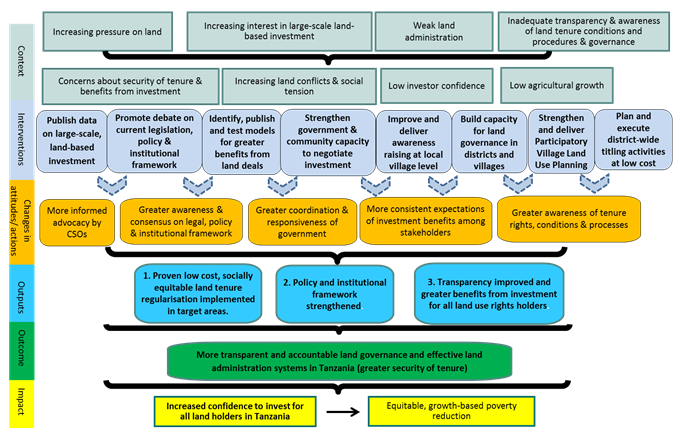
ANNEX C
Implicit assumptions underlying the development logic to achieve the espoused benefits of Initial land Titling (ILT) & improved land administration The following is drawn from Table A3.1 Appendix 3, AusAID (2000). The author was involved in writing this report. 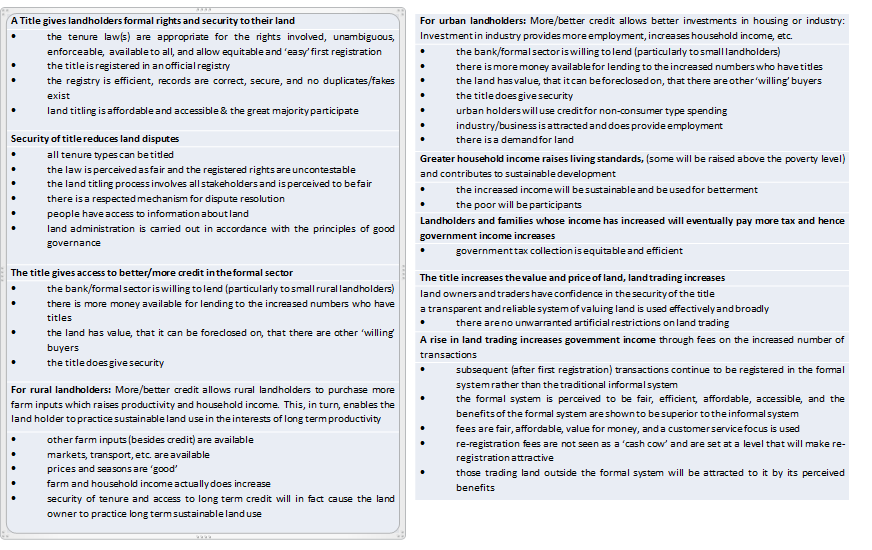
ANNEX D
Illustrative examples of inputs, activities, outputs, outcomes, impacts and major assumptions/conditions for each LA operational entity
A - First Recording of Private Land/Property Rights into a Government Land Registry
B1 -Improve the operations of a LR (Land Registry)
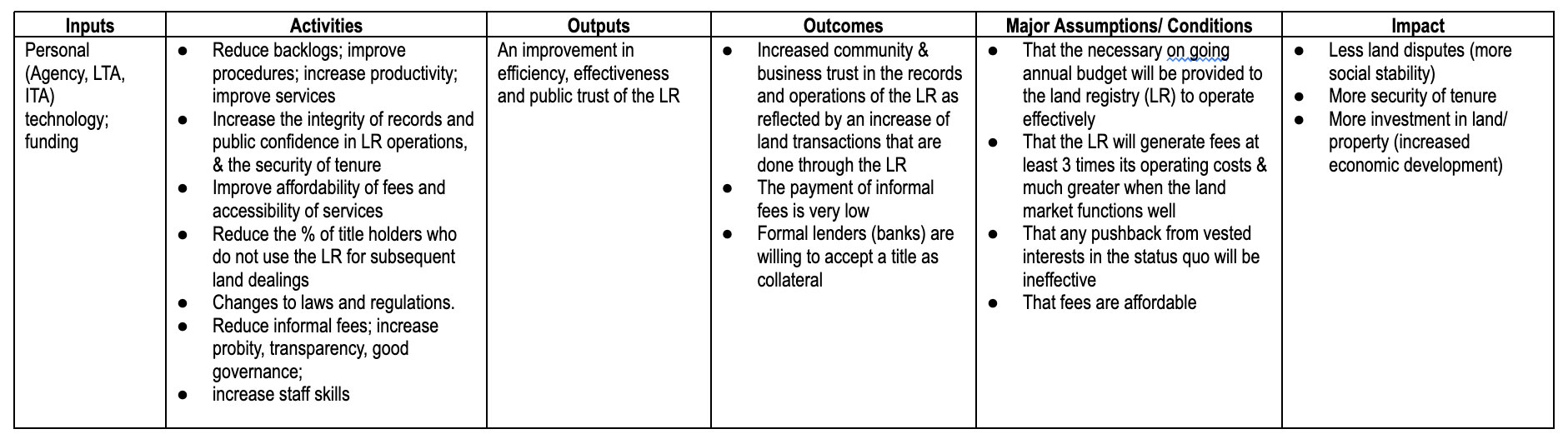
B2 - Develop an LIS (land Information System) [can be included as part of improving/ upgrading the operation of an LR]Personal (Agency, LTA, ITA)technology; funding
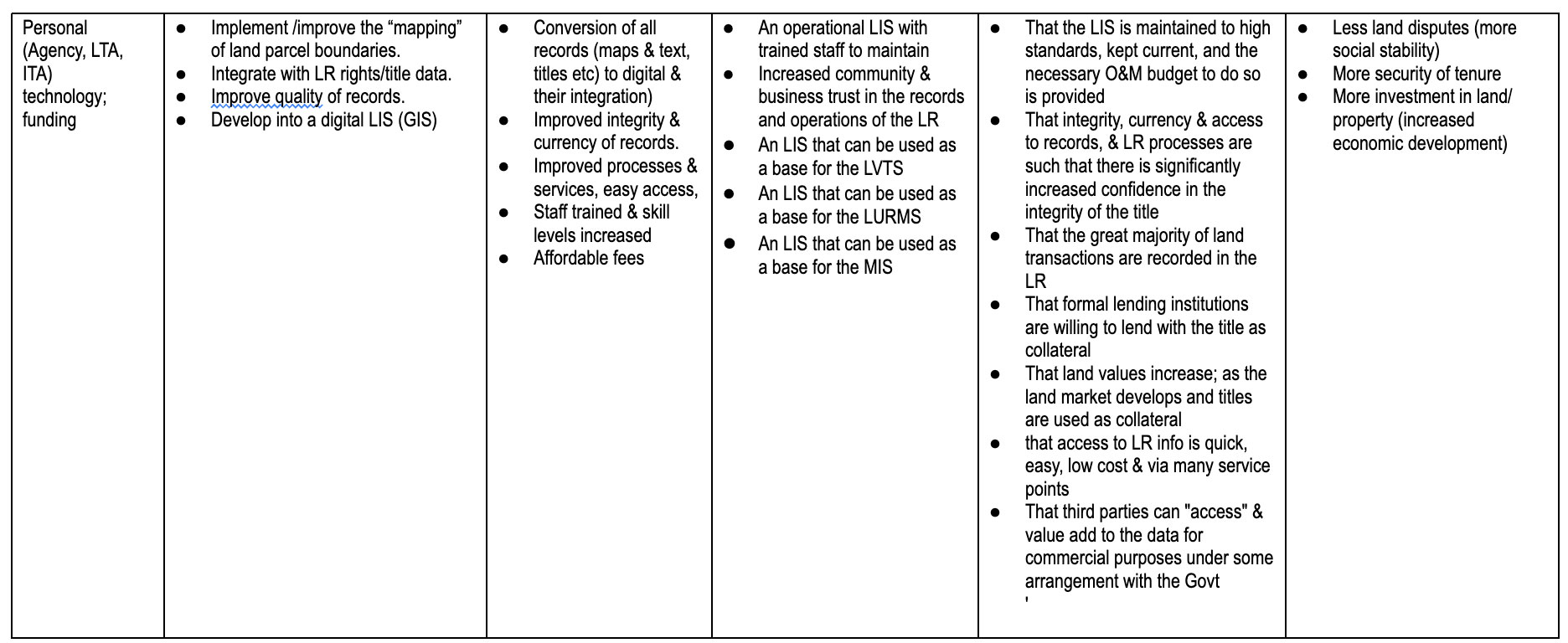
C- Implement/ improve a LVTS (land valuation land tax system)
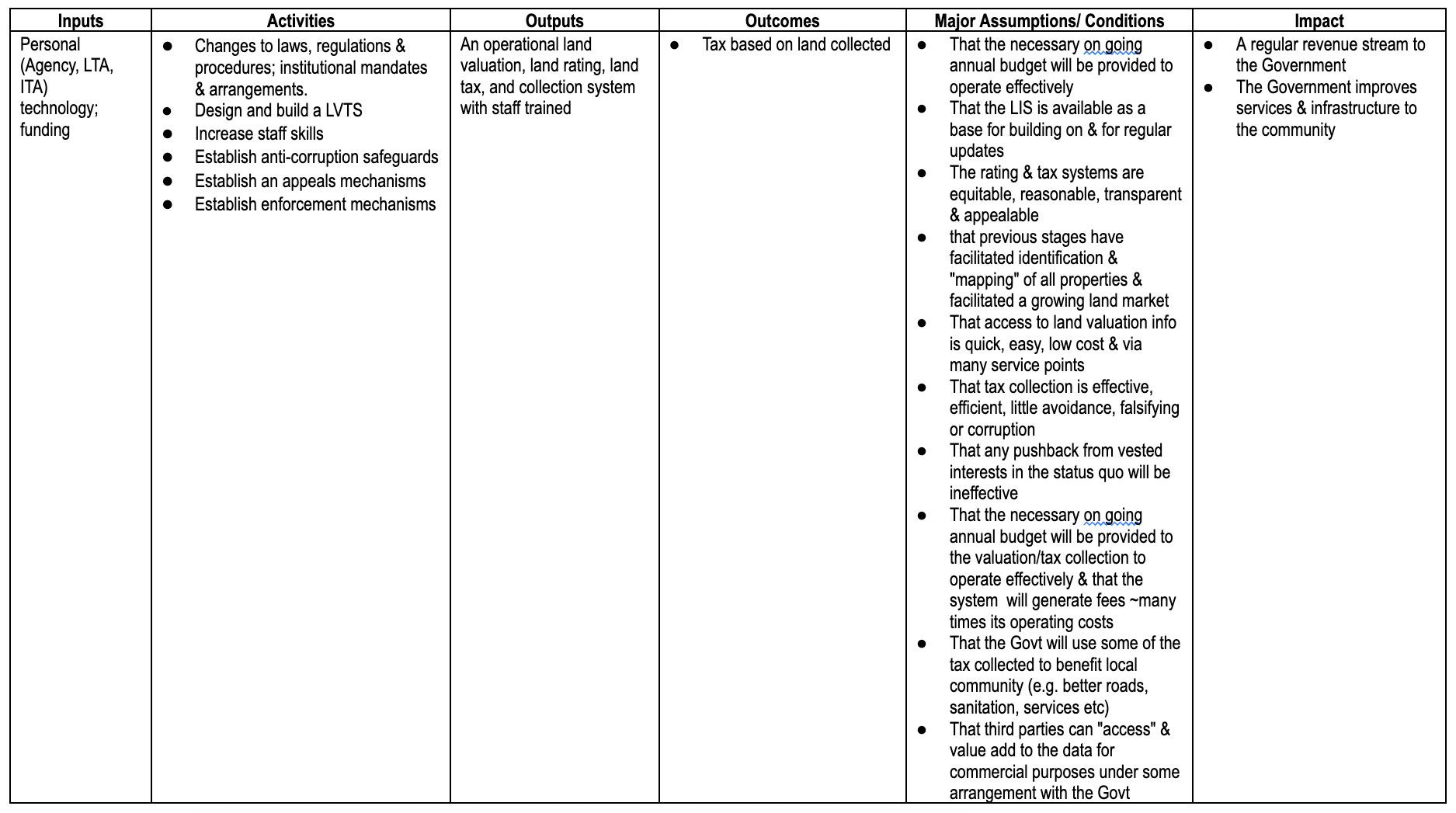
D - Implement/improve a LURMS (Land Use Regulatory and Management System)
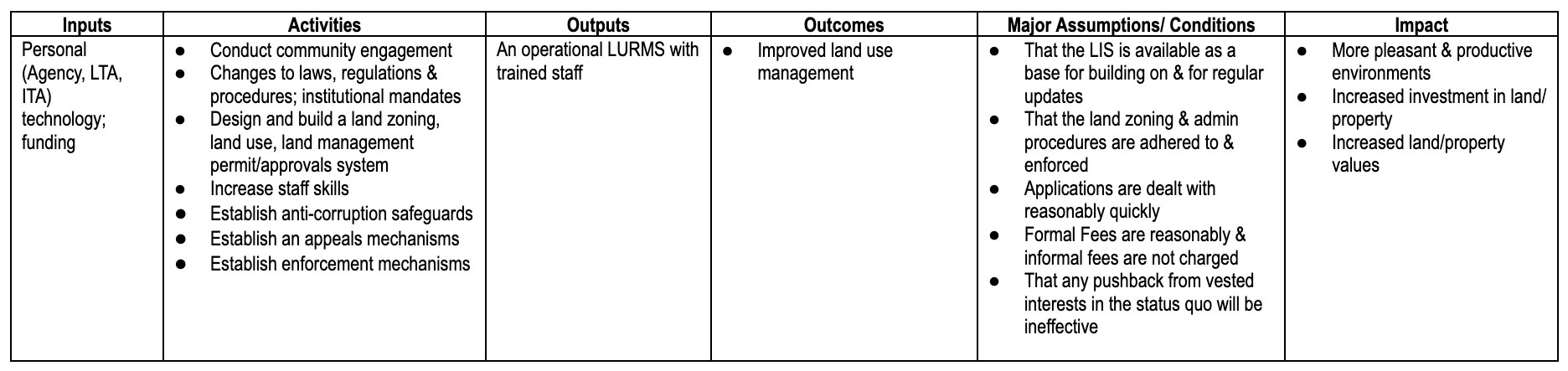
E - Implement/ improve a MIS (Municipal Information System)
F - Implement/improve a Registry of Government land
F2 - Implement/ improve a LVRS (land valuation & land rent system) for Gov Land
ANNEX E
| Abbreviatio | Meaning |
|---|---|
| EC | European Commission |
| DFID | Department for International Development |
| IDA | International Development Assistance |
| IRPR | Initial Recording of Property Rights |
| LA | Land Administration |
| LIS | Land Information System |
| Logframe | Logical Framework Matrix |
| LR | Land Registry |
| LURMS | Land Use Regulatory and Management System |
| LVRS | Land Valuation and Land Rent System for government land |
| LVTS | Land Valuation and Land Tax System for private land |
| MIS | Municipal Information System |
| RGL | Registry of Government Land |
| SD | System Dynamics |
| UK | United Kingdom |
Footnotes
- 1 A title recognised by the state is generally regarded as the highest level of security of property rights. A development project could well have the aim of issuing certificates or similar documents that have lesser standing but are important in pro-poor situations. ↩