
LAND ADMINISTRATION and
INTERNATIONAL DEVELOPMENT ASSISTANCE
Table of Contents
2.0 Introduction
2.1 Land Administration and differences between developed and developing economies
2.1.1 What land administration is
2.1.2 Indicative differences in LA status between developed and developing economies
2.2 The operational entities of land administration
2.2.1 A schema of the various operating entities
2.2.2 Typical Status of the various operational entities in developed and developing economies
2.3 The development gap and international development assistance
2.3.1 The development gap and performance over time (POT)
2.3.2 Where international development assistance has been provided
2.4 Costs and Benefits of IDA - Orders of Magnitude (Qualitative & Relative)
2.5 Revenue to Government and Development Capital made available by using property title as collateral
2.6 Wrap up of prior sections
2.7 If starting LA at a green field site
2.8 The need for an Approach to “Test” the Effectiveness and Sustainability of “Proposals to Improve Performance”
2.9 Changes in Land Administration tend not to happen quickly
2.10 Key Points
Figures
2.1 Indicative differences in the status of LA between developed and developing economies.
2.2 A schema of the various LA operational entities
2.3 Depicting a development gap via a POT graph
2.4 Costs and benefits (qualitative & relative) of IDA projects for each LA operational entity.
2.5 Sources of revenue to government and of development capital
2.6 Bench testing proposals for improvement
Annexes
A. A brief description of each LA operational entity.
B. Indicative ratings for each operational entity that compare the status in developed and developing economies
C. Some illustrative POT graphs for the various operational entities.
D. Illustrative POT graphs for the LR (Land Registry)
E. Typical IDA that has been provided
F. Costs and Benefits of IDA - Orders of Magnitude (Qualitative & Relative)
G. Abbreviations Used
CHAPTER 2
LAND ADMINISTRATION and
INTERNATIONAL DEVELOPMENT ASSISTANCE
2.0 Introduction
In Chapter 1 it was noted that land/property rights are a fundamental factor in a country’s social stability and economic development, and that developed economies have security of tenure, enforceable land and property rights, and effective land administration systems; while in developing economies significant amounts of land/property are commonly not formally registered, the legal, regulatory and organisational base of land administration is generally not fully in place, nor fully effective, and much tenure may be seen as insecure.
The purpose of this chapter is to: -
- provide for non land administration (LA) specialists a sufficient understanding of LA for subsequent chapters where the Strategy Dynamics (SD) approach to improve the design of international development assistance (IDA) projects in LA will be illustrated
- not provide full details of LA in either developed or developing countries, as these can be found in the literature
The chapter covers (in outline): -
- what LA is and its major operational entities
- the typical operational status of the major operational LA entities in developed and developing economies
- typical IDA that has been provided seeking to improve the operation of a part, or the whole of one or more operational LA entities
- the costs and benefits of IDA, indicatively, qualitatively, and orders of magnitude,
2.1 Land Administration and differences between developed and developing economies
2.1.1 What Land Administration Is1
Land administration (LA)can be considered as: - the setting of the "rules of the game" – policy, laws and regulations; the necessary institutions with their roles clearly defined, and procedural mechanisms in place; provision of the necessary land services; the wide and ready provision of information on the legal and market status of land and the operation of the “land admin system”; the provision of independent dispute and appeals mechanisms; ensuring that the goals of LA are achieved.
The goals of LA are to: -
- Provide secure and enforceable property rights
- Contribute to social well-being and stability
- Contribute to economic development
- Provide a well ordered, regulated and functioning property market
- Provide land services
Some major characteristics an effective LA should exhibit are: -
- To have people's confidence
- To exhibit good governance
- Be affordable to the government to run
- Be attractive to use
- Be affordable to users, easy to access and to comply with.
There are a myriad of approaches and technical tools. These include: - deeds, titles, title insurance, paper or computer assisted or computer based registries; marked, unmarked, surveyed boundaries; etc. While all these tools are valid and have their place, caution must be exercised in seeking to improve particular aspects of an operation using one or more tools, as making a particular aspect run more efficiently may have little impact on the operation of the “system”, or on the achievement of the goals of LA.
There is no one true LA system. Systems in countries such as United Kingdom, Australia, and USA are all different, but they all achieve the goals of LA, albeit in different ways, and with different operating and compliance costs. Care needs to be taken in IDA that a particular developed country’s LA system is not considered “the best”, and thus considered appropriate for a particular developing economy. Recognising the culture of a country and its existing tenure arrangements (in law and custom) is very important.
It is necessary to keep in mind that LA is a means to an end, (that is its goals) and not an end in itself, and thus it is important to distinguish this from the many technical tools used in LA. Specialist technical advisers in IDA need to be careful to keep the goals of LA in sight, as well as the technical details of their specialty.
Dale and Baldwin (2000) provide a useful three pillar model of land markets and five necessary but not sufficient requirements to guarantee an efficient and effective land market. Lyons et al 2002a, b expanded the three pillar model.
Lyons et al 2002a,b have argued that in Australia the objectives of LA are more implicit than explicit, and that LA operational structures have grown up over long periods of time and are now so complex that only experts understand certain parts. Subsequent unreported work indicates that the costs to government in Australia in running the LA system, and to users in complying with, are high and largely unrecognised.
2.1.2 Indicative differences in LA status between developed and developing economies
Figure 2.1 shows some indicative differences in the status of LA between developed and developing economies, drawing on the author’s experience.
Figure 2.1 Indicative differences in the status of LA between developed and developing economies.
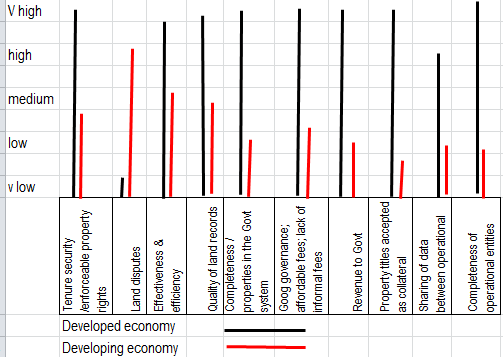
The challenge for IDA is to improve the performance of LA in developing economies sufficiently and sustainably, so that goals of LA can be achieved, viz contribute to social stability and economic development and that the improvements can be sustained, post aid, when reliant on incountry budgets.
Figure 2.1 is general and indicative. There will be differences between individual countries, and this can be seen by examining the rankings in World Bank Doing Business for transferring a property2.
The next section will look at the main components or operational entities that make up LA.
2.2 The operational entities of land administration
In practice LA is not neat and tidy, it can be quite messy. There are a number of operating entities (see Fig 2.1). Each operating entity can have several pieces of legislation and numerous regulations; different responsible organisations, each with their own mandate, cover different geographical areas, and operate largely independently; each can operate at different levels of efficiency, effectiveness, transparency and governance.
2.2.1 A schema of the various LA operational entities
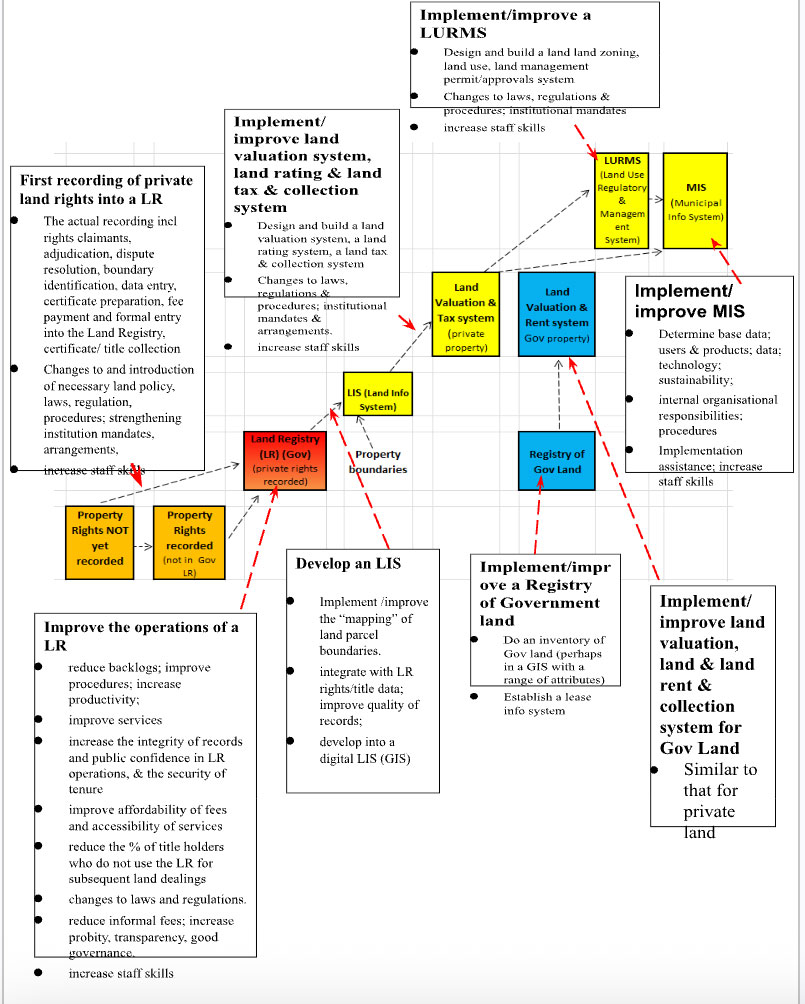
Figure 2.2 is a schema of the various LA operational entities. Annex A provides a brief description of each entity.
Figure 2.2 a schema of the various LA operational entities
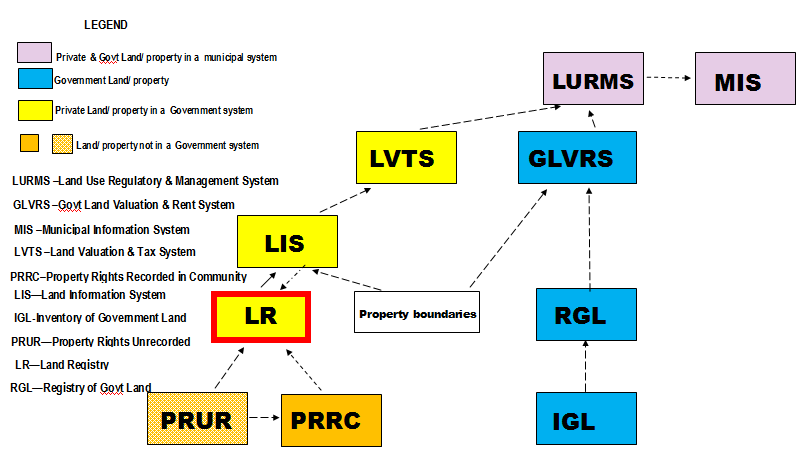
The core operational entity (shown in red) is the Land Registry (LR). The purpose of the LR is to hold correct and current records of private property rights, and for all property dealings to be conducted via the LR, thus ensuring that tenure is secure, and formal lending institutions can rely on the veracity of LR records when considering whether or not to accept property as collateral for a loan.
The blocks shown in orange are downstream of the LR and show rights not yet recorded in a Government LR. The process of initial determination and recording of rights is the legal process in which land rights are brought into the government LR and documentation3 provided to rights holders. Some rights may have been recorded by a community and the records held in a community system from following a Fit for Purpose (FFP) approach45.
The blocks shown in yellow can be considered upstream of the LR as data on property typically flows quickly from the LR in developed economies. In developing economies, if some of the upstream entities exist, it is common for them to be largely independent of LR data as different Agencies have responsibility.
The blocks in blue depict government land. It is common for this to be in a system separate from registered private land/property. Customary land can again also be a separate system.
Each operational entity can be considered as a system in its own right. The arrows depict paths that data may follow. Effort and costs are incurred in moving data “upstream”. An analogy would be the energy (and costs) required to pump water to higher levels, and then to maintain it there in the holding system. IDA projects can involve improving one or more aspects within a particular operational entity or involve more than one operational entity.
2.2.2 Typical Status of the various operational entities in developed and developing economies
The differences shown in Fig 2.1 also typically apply to each LA operational entity.
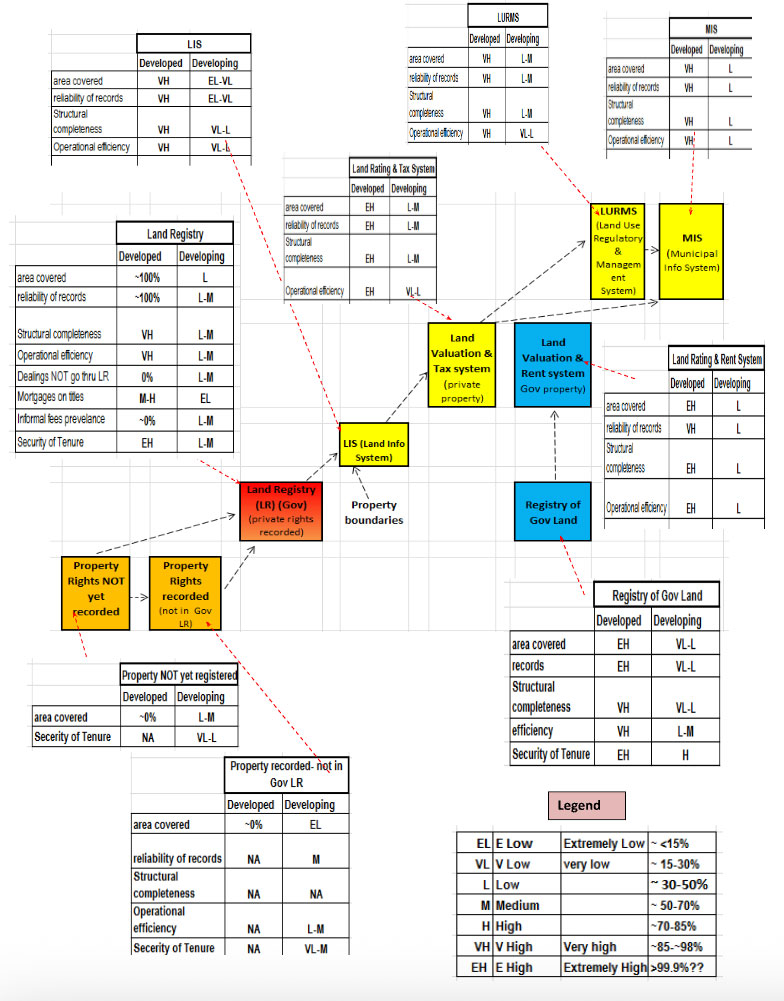
Figure 2.1 is broad and general. Annex B shows for each operational entity, what might be typical ratings that compare the status of each entity in developed and developing economies. A legend is provided at the bottom right of the Annex.
The criteria/items used for comparison in Annex B have some variations but essentially relate to: -
- % of land where rights have been formally recorded
- how reliable, complete and up to date records are.
- level of “structural completeness” (AusAid 2001), (i.e. how complete and appropriate are elements such as - policy, laws & regulations, governance, institutional arrangements, services provided, procedures, records);
- “operational efficiency” (AusAid 2001), i.e. (level of disputes, service completion, backlogs, customer satisfaction; levels of malpractice, etc.)
- in addition, for the LR, the % of dealings that do NOT go through the LR; level of mortgages using titles as collateral.
The ratings used in Annex B are still broad. There will be differences in individual countries and different ways of making assessments. Dale & Baldwin (2000) provide useful check lists and a methodology. World Bank (2014) provides a useful framework for assessing land governance. Anon (2013) and World Bank (2014) show the results from applying the World Bank framework in the Philippines.
There can be much debate can be about what might be the best comparison items and rating system. At the comparison level of Annex B, there will be subjectivity.
The bottom line is - that whatever comparison criteria are used there will be a gap between developed and developing economies (probably large in many respects). If it is accepted that LA is necessary to contribute to social stability and economic development, then the IDA challenge is to largely close the gap and have ratings close to those of developed economies.
2.3 The development gap and international development assistance
Because of the social and economic importance of land/property (Chapter 1), and the gap in the effectiveness of LA between developed and developing economies (Sec 2.2.2), much IDA has been provided to developing countries by development banks and the aid agencies of developed countries.
2.3.1 The development gap and performance over time (POT)
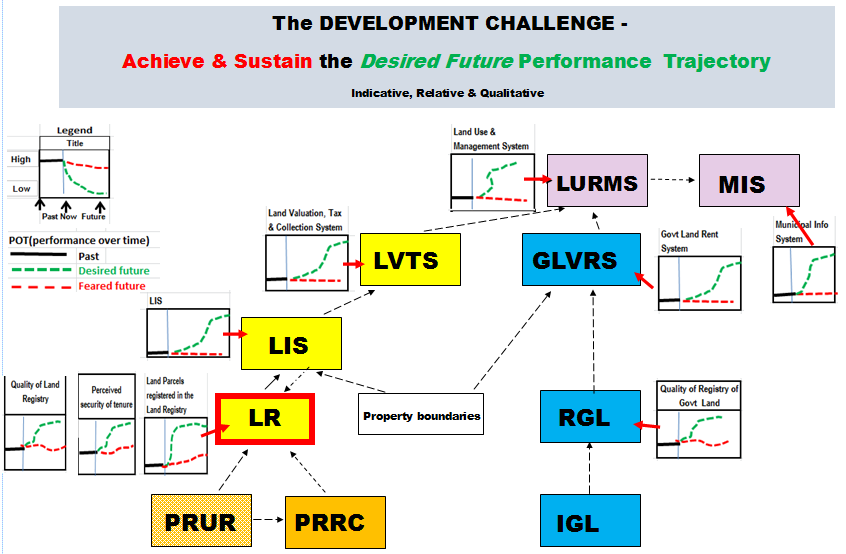
A useful way to depict a development gap is via a POT graph. A schematic is shown in Figure 2.3.
Figure 2.3
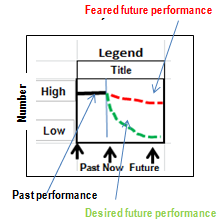
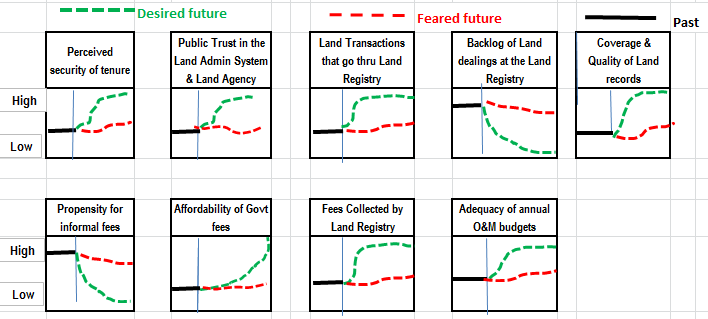
The trajectory of past POT (up to the current time) is shown by the solid black line in Figure 2.3. The trajectory of feared future POT (if no improvement is made) is shown by the red dashed line. The trajectory of the desired future POT is shown by the green dashed line.
To achieve the desired future performance IDA will probably be necessary. The desired future POT trajectory is shown as gradually improving and then flattening out as the desired level/goal is reached, and sustained. This is the ideal.
Annex C shows some illustrative POT graphs for the various operational entities. For the LR a single POT is shown for Quality of the LR. The LR is a core operational entity and there are various aspects that contribute to quality. Annex D shows illustrative POTs for these contributing elements. As the POT graphs in Annexures C & D are illustrative no numerical scales have been included. Illustrative example of seeking to improve Quality in the LR is provided in Chapters 9 and 10.
POT graphs are an important part of the SD (Strategy Dynamic) approach and more detailed examples are given in later chapters.
2.3.2 Where international development assistance (IDA) has been provided
The types of IDA can involve: -
- improving one or more aspects within a particular operational entity, e.g.
- removing a processing backlog in a Land Registry (LR); (example in Chapters 4 and 5)
- increasing the efficiency and effectiveness of an entity as a whole (e.g. an LR) via increasing its quality and reputation; (example in Chapters 9 and 10)
- moving from one entity to another, e.g.
- carrying out initial land/ property rights registration (example in Chapter 14.)
- creating an LIS (land information system) by merging LR data with property boundary data
- using an LIS as the base for establishing a LVTS (land valuation and property tax system)
Annex E shows some high level IDA activities that have been used to improve LA operational entities.
Examining Annexes C, D & E gives a general idea of the development gap in LA between developed and developing economies, and the size of the task to significantly reduce that gap; [assuming that effectiveness in LA needs to be somewhere close to the effectiveness level of developed economies, to achieve widespread social stability and provide a base for economic development].
Given the likely size of the performance gap that may need to be bridged, and the range of likely activities, the decision on what the focus of IDA will be, and which activities might be included in an IDA supported project, will depend on the needs, priorities and capabilities of the recipient.
2.4 Costs and Benefits of IDA - Orders of Magnitude (Qualitative & Relative)
Projects to improve LA can require total funding from all sources, including IDA of between $5-600m and have durations of 5-20 years over several phases. Costs and durations will depend on: - project scope (which entities are included): size of the country/target areas and the number of parcels of land/properties to be included; the size of the development gap (the current status/rating of LA) and the rating being aimed for).
Costs
A distinction needs to be made between (once off) project cost, generally largely met by IDA, and (annual and ongoing) O&M (operation and maintenance) costs, which have to be met by the in country land agency.
Benefits
A distinction also needs to be made between social and economic benefits.
Social benefits flow immediately to people whose land/property rights are registered in an LR for the first time, as that person now has legal proof to ownership; their tenure is more secure and they have considerably less danger of a land dispute or arbitrary eviction. An important provider of social benefits is the FFP (fit for purpose) approach to LA coupled with the use of the SDTM (Social Domain Tenure Model)6 of the GLTN (Global Land Tool Network7) for the community based approaches to initial land rights recording.
Economic benefits tend to flow much more slowly and gradually increase over time. e.g. it may take some years, post an IDA project, for an LR to become a significant net source of income for the government, through the fees and taxes paid on land transactions. To become a significant net source of income it will be necessary for titleholders to trust the LR, and to put their land transactions through the LR. Also, the land market will need to developed to the stage where there is a reasonable volume of property transactions.
Orders of magnitude (qualitative and relative) of costs and benefits
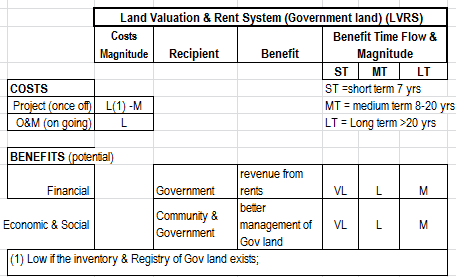
Figure 2.4 is a simple schematic attempt to depict the possible relative and qualitative magnitude of cost and benefits of IDA projects for each of the operational entities. This schematic may be thought of as a general working hypothesis. When applying the SD approach to particular LA proposed improvement projects in later chapters, costs and benefits will be quantitatively calculated.
Figure 2.4
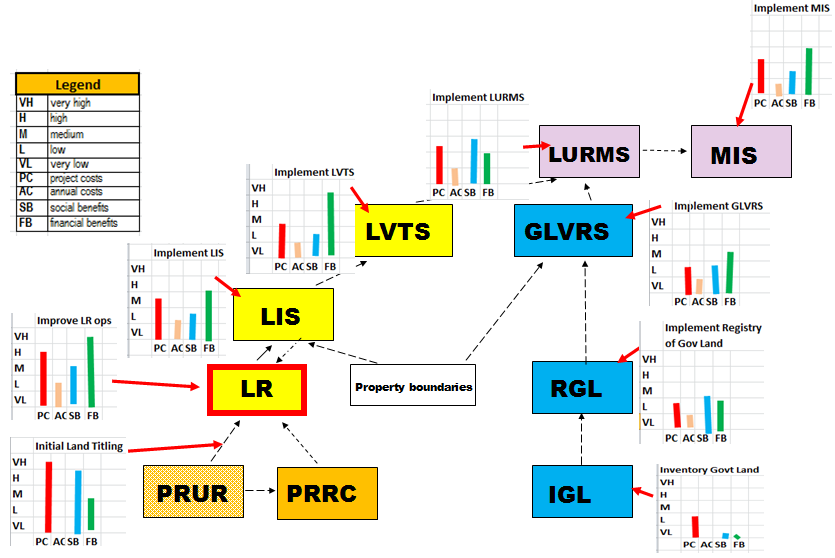
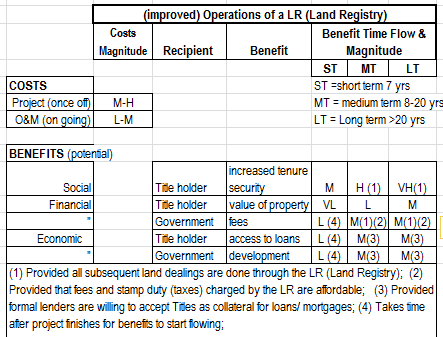
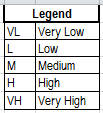
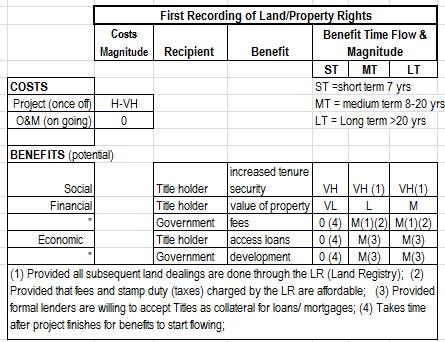
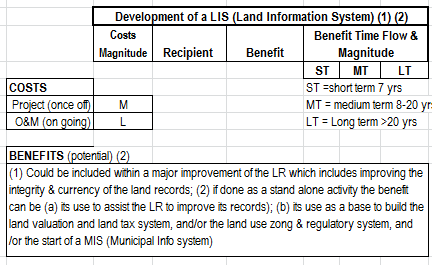
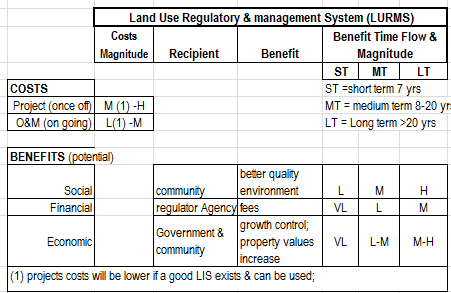
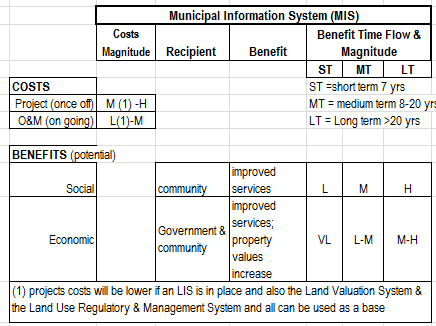
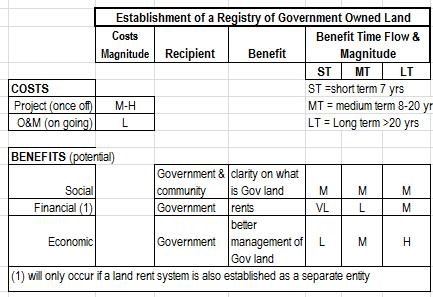
Figure 2.4 is simple and indicative. It does not take into account the likely time flow of benefits or any conditionality. Annex F gives some indication of the likely time flow of benefits (short term < 7 years; medium term 8-20 years; long term > 20 years), and the conditionality. Some examples of conditionality are:-
- that once land/property is registered, all subsequent property dealing will be carried out through the LR
- that the records in the LR are highly reliable; that the LR is held in high repute; that formal lenders are willing to accept property as collateral
- that the LR is willing to readily provide its property base and maps to upstream operational entities (e.g. land valuation and taxation)
If the conditionality is not achieved, then costs are likely to be much higher and benefits much lower.
Annex F is still qualitative and relative and should be considered as indicative, and a general working hypothesis. It will be seen in later chapters that the SD (strategy dynamics) approach provides a quantitative and transparent methodology for the handling of conditionality (causality), and the determination of costs and benefits under any identified assumptions and scenarios.
2.5 Revenue to Government and Development Capital made available by using property title as collateral
Figure 2.5 builds on Figure 2.1 and indicates where the main sources of revenue to Government and of development capital come from.
Figure 2.5
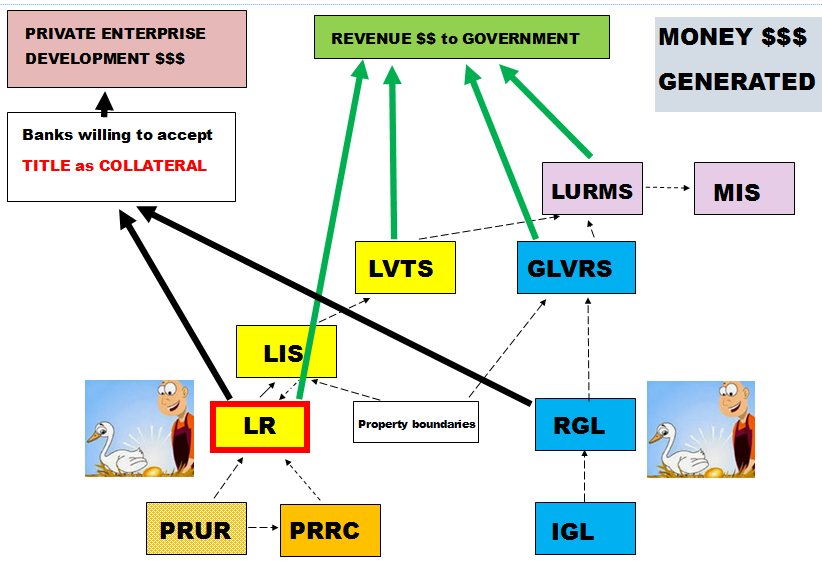
Revenue to government is relatively easily collected. The magnitude collected depends on the quality of systems in place, good governance, the strength of the property market, and the number of properties in the system. In developed economies the sums collected are significant. The magnitude of these revenues and their importance to state government finances can lead to the LR and the LVTS as being the “goose that lays the golden eggs”. In Australia from 2018 the Government of Victoria reportedly8 obtained A$2.86b from the privatization of its LR, while New South Wales (NSW)9 got $2.66b for a 35 year lease, South Australia10 got $1.60b, Western Australia11 $1.41b. These LRs vary in size. NSW was reported to collect ~$190m/yr in revenue and make ~$130m in profit.
In developed economies significant amounts of capital are raised for titleholders by banks willing to lend based on the security (quality) of the title12.
A relatively recent report, Satana et al (2014), reports on the economic impact of 20 years of ECA (Europe and Central Asia) Land Registration Projects (13 projects). The summary table shows some impressive impacts. viz 80-90% reductions in backlogs and waiting times; fiscal impact of US$13m; increase of 200% in mortgage loans; increase property tax collection of euro 4.74m. A challenge is to have IDA results such as these the norm.
In the example in Chapter 9, revenue to government with and without the improvement IDA project is shown. The provision of development capital based on banks being willing to lend, based on the security of a title, is covered in Chapter 13.
2.6 Wrap up of prior sections
The aim above is to provide a snap shot, with limitations, of the various LA operational entities (Figure 2.2), what might be typical ratings in developed and developing economies (Figure 2.1, Annexures B & C), typical IDA that has been provided to improve the status of particular operational entities (Annex D), and what can be costs and the time flow of benefits (Figure 2.4 and Annex E).
The underlying premise is that the status/rating of the main LA operational entities (e.g. the LR, the LIS, the LVTS) needs to be somewhere close to those of developed economies, if the desired contribution of LA to social stability and economic development can take place. [Social stability is achieved by tenure security, less land disputes etc., and economic development via secure tenure, land records of integrity in the LR, high public confidence, and formal lenders” willingness to lend with the title as collateral, thus leading to a virtuous circle of economic development, increased property prices and land market activity.]
The development challenge is to determine a strategy for IDA that will lead to a change in ratings that will have the effect, over time, of contributing to social stability and economic development, and that will be sustainable, post IDA.
2.7 If starting LA at a green field site
If starting at a green fields site
If starting LA from scratch in a particular economy, the first task is to thoroughly understand the context and culture13 of land and property rights, then with current technologies. Onedevelopment scenario could be-
- Establish a LR (Land Registry)
- Undertake the first recording of all rights, together with boundaries, as quickly as possible by discreet priority geographical areas. At the same time: - develop a LIS in the land registry, upgrading and integrating current land registry holdings; providing quality land services; work with other key players to facilitate access to credit based on tenure security
- Use the LIS as a base to quickly develop an LVTS (land rating and land taxation system); and, in turn develop the LURMS (land use and management system), and lay the base for a MIS (Municipal Information System).
The rationale for the above would be along the following lines: -
- The first recording of all rights and boundaries provides the basis for subsequent land dealing to be recorded in the LR. However, first recording, the development of an LIS, and attaining and maintaining very high data integrity is high cost, largely once off, and commonly requires significant IDA loan funding. The social benefits of secure land tenure to landholders flow quickly, but any income flow to government through fees, is relatively small and slow to grow
- A major attractor to landowners to register their land dealings in the LR, after the initial right recording, is the completeness and integrity of the LR records and services. Public recognition of this, together with the willingness of formal lending institutions (e.g. banks and similar) to accept the Title to land as collateral for a loan. If these are in place, use of the LR will grow, and, with it, revenue to government from LR fees. [NB- if use of the LR does not occur it is likely that, over time, the benefits of initial land recording will fall, negating much of the investment made].
- Significant income to Government will only occur from an effective LVTS. Some of this revenue stream can be used to pay off the IDA loan.
Projects do not start from scratch
Obviously, a project does not start from scratch and in most developing countries; some LA operational entities will already exist that may have a rating somewhat similar to those shown in Figure 2.1 and Annexures B & C. There is no shortage of possibilities for IDA (Annex D). The challenge is to select appropriate objectives and strategy.
2.8 The need for an Approach to “Test” theEfficacy and Sustainability of “Proposals to Improve Performance”
There is a gap, commonly large, in the status in LA between developing and developed economies. (Figure 2.1, Annexes B & C refer). IDA can be provided to assist to close the gap (Annex D).
If it is accepted that largely closing the LA status gap is a necessary but not sufficient condition to increase social stability and economic development, then the development challenge is to: -
- Determine an appropriate strategy that will assist to close some of the gap
- Select IDA project objectives that are highly likely to be achieved
- Seek sustainability of benefits, post IDA
There is generally no shortage of proposals to improve performance (PTIP) particular aspects of LA in developing economies. Most of the major decisions re strategy, objectives and assumptions (explicit and implicit) are made during IDA project design.
IDA project design in LA tends to be both science and art.The science comes from an understanding of the structure of LA and the characteristics of the technology and methodologies that are available to be used. The art comes from hard won wide experience and a "feel for”: - what will work; what can be achieved; what is doable in a particular operational environment and the degree of buy in; project costs and benefits, and what might be able to be sustained, post IDA.
It is contended that there is a need for a design approach that will complement and add value to existing design approaches, and which will: –
- Increase science in project design
- Allow the "testing” (quantitatively, transparently, all assumptions clear and explicit) “for effectiveness and sustainability” of “performance improvement proposals” (PIPs) during project design, and before large funding is committed. Or, putting it another way, assist in developing an IDA project strategy which will have a good chance of achieving project objectives, and be sustainable, post IDA
- Also capable of being used in design appraisal and M&E (monitoring and evaluation)
The above can be considered analogous to bench testing or the use of a wind tunnel. Figure 2.6 refers.
Figure 2.6 Bench testing proposals for improvement (a lighthearted look at testing in a wind tunnel)

It is considered that Strategy Dynamics (SD) is such an approach. SD will be introduced and its use illustrated in the following chapters of this booklet. Chapter 8 covers what the contribution of SD is, and how its use adds value. It is considered that SD’s big contribution is to explain how and why systems generate the changes to performance outcomes that occur over time, and enable bench testing of strategies and policies to make substantial, sustained improvements to those outcomes.
2.9 Changes in Land Administration tend not to happen quickly
History tends to indicate that a country’s land and property rights, and administration and management arrangements, evolve slowly over long periods of time, frequently decades and even hundreds of years. Even where there are significant changes due to new legislation or upheaval, these are often preceded by long periods of debate and often agitation. De Soto (2000), comments on the evolution of property rights in the USA. Linklater (2002), whilst focusing on USA land property measurements, provides some interesting social evolution context.
An examination of important “land” dates for the state of New South Wales, Australia over the 240 years since white settlement, indicates that LA did not proceed without problems and that it evolved slowly through many fairly frequent changes, (NSW Lands Department (2008). Grant (2009), a former NSW Surveyor General, comments that even in the mid-1980s, when a range of relatively uncontentious evolutionary changes were sought, it took up to 25 years to bring them to fruition even though NSW was a state with a long and stable democracy, competent governments, quality universities and professional societies with land disciplines, good infrastructure and telecommunications. Some interesting insights into the effort to transform Britain’s public services are provided in Barber (2008).
Some Australian local governments (Municipalities) have been able to fully implement MIS (Municipal Information System) within 5 or less years. The vast majority of these have land parcel numbers many times those of Pacific countries, but much less than municipalities in many populous countries. Some of the reasons for this success are considered to be: -
- A well-functioning and highly trusted LR at the state level
- A statewide LIS largely in place
- A single focus municipal organisation and no other government agency with a related mandate over the same geographic area
- Municipal senior management is relatively small and committed to improving service to customers
- The technology was available and affordable, as was a skilled private sector to assist in planning, implementation and maintenance
- Quite favourable cost benefit analysis (CBA) and return on investment (ROI)
Delays, for whatever reasons, can have a major impact on the performance of an LA “system”. Delays can be taken into account quantitatively in the SD approach, and will be illustrated in later chapters.
Conclusion: The LA systems in developed countries have evolved slowly, over hundreds of years to the sophisticated, complex and costly (to run and to comply with) systems that exist today. Their workings are largely invisible and taken for granted. Change, even in the early 21st century, tends not to happen quickly.
This gives rise to the following questions: -
- Is it reasonable to expect developing countries to be able to evolve their systems significantly faster (even with IDA), than it took today’s developed countries?
- Is the typical time span of 3 to 5 years for IDA land projects appropriate? Especially where sustainability of benefit flow, post IDA, is deemed so important.
- What are possible roles for IDA in LA, and over what time frames?
In the following chapters where SD is outlined and illustrative examples of its use in “testing” for performance improvement and sustainability of the improvement are provided, the above questions can be examined as an important feature of the SD approach is that it provides quantitative measures of the rates at which things change, or are anticipated to change.
2.10 Key Points
References
• LA is essentially the “setting of the rules of the game”, including safeguards; it is a means to an end. The end being the Goals of LA; viz contributing to social stability and economic development. LA is composed of a number of operational entities
• Land administration is more advanced and effective in developed economies
• International Development Assistance (IDA) has been provided over many years to improve land administration in developing economies. However, the attainment and sustainability of widespread benefits tends to be illusive
• The underlying premise to IDA in LA is that improving the status of LA to near that of developed economies will significantly contribute to increased social stability and economic development.
• There is a need for an approach that will complement existing approaches, and which will allow the “testing” (quantitatively, transparently, all assumptions clear and explicit) “for effectiveness” of “performance improvement proposals” (PIPs) during project design, and before large funding is committed.
• Is it reasonable to expect developing economies LA to improve significantly fast, even with significant IDA, over the relatively short periods of 3 to 5 years, and even 10 years, given the magnitude of some LA improvements, and the desire for long term sustainability of benefit flow, noting that in developed countries, changes to LA have mostly not occurred quickly, but rather have evolved over decades and longer.
Anon (2013), Land Governance Assessment framework in the Philippines, http://siteresources.worldbank.org/INTLGA/Resources/Philippines2.pdf
AusAid (2001), Undertaking land Administration Projects: Sustainability, Affordability, Operational Efficiency and Good Practice Guidelines, Quality Assurance Series No. 26 July 2001
Barber M, (2008), Instructions to Deliver – Fighting to Transform Britain’s Public Services, London, Methuen.
Dale P, Baldwin R (2000), Lessons learnt from the Emerging Land Markets in Central and Eastern Europe, FIG (International Federation of Surveyors) Working Week Prague, May 2000,
Grant D (2009), Personal Communications.
De Soto, H. (2000), The mystery of capital: why capitalism triumphs in the west and fails everywhere else, Basic Books
Linklater A, (2002), Measuring America - How the United States was shaped by the greatest land sale in history, Harper Collins
Lyons K. Cottrell E. Davies K, (2002a), On the Efficiency of Property Rights in Queensland, Research Report Queensland Department of Natural Resources and Mines, Brisbane
Lyons K. Cottrell E. Davies K, (2002b), The Case for Refocusing and Reengineering Land Administration to better Meet Contemporary and Future Needs in Property Rights and Markets, Proceedings of Joint AURISA and Institution of Surveyors Conference, Adelaide, Australia
Lyons K, H Hebblethwaite (2010), Using Microworlds to Improve Success and Sustainability in Land Development Assistance Endeavours, FIG Congress Sydney
New South Wales Lands Department, (2008), List of Key Dates.
Satana S, M Torhonen, A Anand Jr, G Adlington (2014), Economic Impact of 20 years of ECA (Europe and Central Asia) Land Registration Projects.
World Bank (2013), World Bank (2014), The Land Governance Assessment Framework (LGAF), Global Experiences & Lessons Learned from the Philippines; authors F Eleazar, K Bell
World Bank (2014), The Land Governance Assessment Framework (LGAF), Identifying and Monitoring Good Practice in the Land Sector; authors Deininger K, H Selod, A Burns, https://openknowledge.worldbank.org/handle/10986/2376
ANNEX A
A brief description of the various LA operational entities
| Operational Entity | Function | Agency Typically Responsible | Comments |
|---|---|---|---|
| Government Land Registry (LR) of private land/property rights | To hold titles and records of rights to land/property, and to record all subsequent transfers or dealings in those rights. The reliability and veracity of the records should be of the highest standard. | The LR may be the responsibility of either a Department of Justice (DOJ) or Department of Lands (DOL). A DOJ may be responsible for titles and documents held in the LR, together with the operation of the LR. A DOL may be responsible for maps of the boundaries of individually titled land parcels. | Commonly termed the formal system. |
| Land/property rights not yet registered | This is not an operating entity as such, but rather a state for land that has yet to be brought onto the register and lodged in the LR through a process of initial land rights registration (ILRR). | N/A | Commonly termed the informal system. Land transactions may still occur outside the formal register. |
| First recording of private land rights via a Fit-for-Purpose (FFP) approach | To record current rights through a community-led initiative, with records held by the community. | Government agencies may not be involved. | A recent innovative approach championed by the Global Land Tool Network (GLTN) of UN-Habitat, Nairobi. This could be termed the semi-formal system. |
| Land Information System (LIS) | To provide a seamless map/database of integrated land parcel boundaries with integrated property information, kept updated through data from the LR. It provides base data for the land valuation and tax system and other associated entities. | A Lands Department and a Land Registry cooperating. | Involves integrating title/rights information from the LR with maps of land boundaries from a DOL, converting them to digital format, and applying extensive quality assurance (QA). |
| Land Valuation and Tax System (LVTS) | To provide a systematic and equitable way for government to calculate, levy and collect taxes based on the value of land held. | Department of Finance, in cooperation with a Land Registry, a Lands Department and a local municipality. | Effectiveness is best when based on data from an LIS and LR, and when that data is kept current. |
| Registry of Government Land and land rent system for government leases | To provide an inventory of government land and a systematic, equitable way for government to set and collect rent on land it owns and has leased out. | A Lands Department, usually at national level. | Supports better knowledge, management and revenue collection for government-owned land. |
| Land Use/Zoning Regulatory and Management System (LURMS) | To provide a land use/zoning and regulatory system against which development can be assessed, approved, managed and monitored. | A Lands Department at national level, provincial government and individual municipalities. | Supports land use planning, zoning, development approval and ongoing land management. |
| Municipal Information System (MIS) | To provide a system that assists municipalities to manage their assets and deliver a wide range of services to their communities. | Individual municipalities. | Supports municipal planning, service delivery, asset management and local administration. |
ANNEX B
Fig 2.2 indicative ratings that compare the status of each entity, for developed and developing economies.
ANNEX C
Some illustrative POT graphs for the various operational entities.
ANNEX D
Some illustrative POT graphs for the elements that contribute to Quality of the LR (Land Registry)
ANNEX E
Typical IDA that has been provided
ANNEX F
The Cost (for improving) - Benefit boxes of the various operating entities of Land Administration
Orders of Magnitude (Qualitative & Relative)
ANNEX G
Abbreviations Used
| Abbreviation | Meaning |
|---|---|
| FFP | Fit for Purpose |
| IDA | International Development Assistance |
| GLTN | Global Land Tool Network |
| ILR | Initial Land Registration |
| LA | Land Administration |
| LIS | Land Information System |
| LR | Land Registry |
| LURMS | Land Use Regulatory and Management System |
| LVRS | Land Valuation and Rent System (government land) |
| LVTS | Land Valuation and Tax System (private land) |
| MIS | Municipal Information System |
| M&E | Monitoring and Evaluation |
| O&M | Operation and Maintenance |
| PI | Performance Indicator |
| POT | Performance Over Time |
| PTIP | Proposals to Improve Performance |
| ROI | Return on Investment |
| SD | Strategy Dynamics |
| QA | Quality Assurance |
Footnotes
- 1 This section is largely based on Lyons et al 2010 ↩
- 2 https://www.doingbusiness.org/en/rankings ↩
- 3 This documentation can take various forms. e.g. certificates, deeds, titles ↩
- 4 https://www.fig.net/resources/publications/figpub/pub60/Figpub60.pdf ↩
- 5 https://gltn.net/download/fit-for-purpose-land-administration-guiding-principles-for-country-implementation/?wpdmdl=7979&ind=0 ↩
- 6 http://ggim.un.org/meetings/2017-Delft/documents/1-B%207%20Cyprian%20Selebalo.pdf ↩
- 7 https://gltn.net/ ↩
- 8 https://www.abc.net.au/news/2018-08-27/victoria-privatises-its-land-titles-and-registry-office/10169056 ↩
- 9 https://www.abc.net.au/news/2017-04-12/$2.6-billion-price-tag-on-nsw-land-titles-registry-sale/8439176 ↩
- 10 https://www.abc.net.au/news/2017-04-12/$2.6-billion-price-tag-on-nsw-land-titles-registry-sale/8439176 ↩
- 11 https://www.watoday.com.au/politics/western-australia/state-sells-rights-to-landgate-data-for-1-4b-says-punters-won-t-see-the-difference-20190910-p52pzp.html ↩
- 12 “title” is used to refer to all names of documents indicating a record of property rights ↩
- 13 This would include such as: -how do rights holders understand their rights; who holds the various rights; how are rights acquired and passed on. ↩